
All-terrain vehicles or ATVs are now gaining worldwide popularity. Well, these are very powerful machines, but most people don’t know how to operate them. Sometimes injuries occur due to accidents because of the rider’s under-training or the rider’s laziness to learn the basics.
In this guide, we will help you get the idea of what proper training for using an ATV is and how to handle an ATV carefully. This will help you to avoid accidents and injuries. Now, let’s get into it!
Everything You Need to Know: Riding Gear for Safety in ATV
Now, let’s focus on some riding gear and VTT safety tips you should know while riding ATVs.
Helmet: Definitely Essential Protection
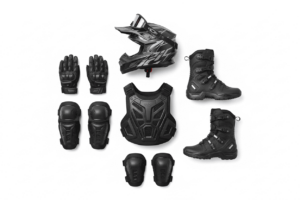
When discussing off-road riding, the usage of helmets for protection is vital, and a full-face or off-road type helmet with visibility ports and chin-guard properties rated DOT or the local equivalent is preferred since open-face helmets offer the least amount of jaw and face protection to the rider in the event of an impact on the front side.
A helmet must fit snugly so that it does not shake on the head in any manner and must have a chin strap that can be secured tightly. Internal ventilation will provide comfort, along with moisture-wicking liners that keep helmet visibility clear.
Clothing and body armour are indispensable; wear long sleeves that resist abrasion, such as motocross jerseys or reinforced jackets; gloves with finger length and good grip, preferably with knuckle protection; use off-road trousers or thick denim, preferably with pad inserts for hip and knee protection; and chest protections, back protections, elbow pads, and knee pads to better protect against injuries.
Footwear should consist of sturdy, above-ankle boots that provide good ankle support; never use sneakers or sandals!
Getting the Right Beginner ATV
In choosing a beginner ATV, pick a power level that is appropriately safe for you, generally 250–400cc for adults and far less for youth, and ensure that you can easily reach the handlebars, controls, and footpegs while supporting your weight. Auto or semi-auto transmissions are best for learning because they will allow you to concentrate on balance and throttle control. If the primary use will be trail riding with a little bit of heavier work, a 200–375cc utility ATV is conducive, while milder sport or versatile utility models are good for learning sport riding. Always sit on the ATV first to check comfort and fit, and be honest about your skill level, trying to impress others by going for too much power can be hazardous.
How To Ride An ATV? Safe Riding Techniques for Beginners
Now, let’s move towards the safe riding techniques.
Safe Mounting and Starting
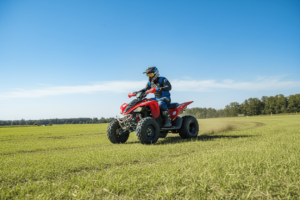
After mounting an ATV, its starting should be safe and involve a controlled procedure whereby a rider mounts from the right side, on smack level ground, with the engine turned off or in neutral; feet are placed on the foot pegs, and the hands remain firmly on the handlebars; while confirming the machine is in either neutral gear or park position (on automatic). With the ignition switch turned on and the choke applied if necessary, the engine is now started after releasing the parking brake: the rider puts the ATV into gear and gently applies the throttle. Thus, the next step is to practice starting and stopping smoothly and under control in an open, level area at very low speeds until good throttle control and brake operation seem automatic.
Balancing Out with Body Weights
Position is the key to making a good ATV rider.
- Keep your body relaxed and active: slightly bent elbows, knees bent; eyes front (never face down!). Keep it flat.
- Your body should be rocked into the turns, and keep yourself low for the purpose of countering the ATVs riding away!
- Your body should be rocked into the turns, and keep yourself low for the purpose of countering the ATVs riding away!
- Moving your weight forward over the handlebars will help to maintain traction on the incline.
Acceleration, Braking, and Turning
Turning: Slow down before entering a turn; avoid braking halfway through a turn. Lean your body into the turn, keep the inside foot on the peg, and avoid sudden steering inputs.
Acceleration Braking: Slightly engage the throttle. Abrupt jerks would endanger traction and result in losing steel wheelies, particularly on the latter two ‘levels’ of very fast or heavy machines.
Braking: You need to learn some feel for the front and rear brakes on each side. On soft ground, maximum rear braking is considered to be appropriate, but controlled use is safer. Definitely off the ground, not all into other brakes.
Behaviour while Riding, and Consciousness
Riding must be made safe, not for the rider but for everyone else sharing the trail.
Respect the Trail Signs: Obey the signs, speed limits, and one-way directions. Do not abuse the environment just to enjoy compromising yourself by moving off the path.
Share the Space: Yield to hikers, horse riders, and slower traffic situations. Lower speed while passing and do not kick up any dust or disintegrate debris.
Pay 100% attention; do not use a phone, earpieces, or show off. Distraction gives room for delays and poor judgments.
Understand your own limits: If anything like a climb, obstacle, or speed feels a little frightening for you, step back; it is okay to walk out the rest.
Common Hazards and Their Avoidance
Now let’s learn some common hazards while riding and how to avoid them:
Unstable Terrain and Obstacles
- Scanned Ahead: Your Eyes Are Always Four to Five Yards Ahead.
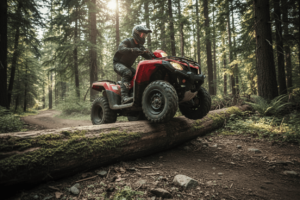
- Moving Slowly: Cross over rocks or logs softly with an angle, allowing one wheel to climb at a time.
- Weight Shift: Barely lighten the front end by shifting back so that the wheels can roll over the obstacle instead of smashing down.
- No jerky moves: Jerky steering and hard braking can make the rider lose balance on an uneven surface. So trust the throttle, steer smoothly, and gently brake.
Slopes
Always travel straight uphill or downhill without cutting diagonals. When riding uphill, lean forward with the majority of your weight, and while descending, lean backwards. On an uphill stall, brake, shift into neutral, and carefully turn either downhill or controlled backwards down as instructed.
While riding through Streams and puddles, ride through the felt and look if you are not sure about the depth or stability underneath. Cross the water at low speed so you maintain traction with a controlled throttle while descending.
When in mud, low gear with the throttle minimises the chances of wheel spin. When stuck, DO NOT full throttle; the more you do, the more chances to get really stuck.
Night Riding & Risks of Group Riding
Night and group riding bring their own challenges.
Night Riding: Check your lights. They must point satisfactorily down the trail before proceeding. Slow your pace; your sight and response may be increasingly impaired. Never ride faster than the distance illuminated by your headlight! In effect, do not ride faster than what you can clearly see your way through.
Free Space for group rides: Creates avoidance against collision or blinding dust clouds between riders’ eyes, or chain-reaction accidents between riders. Staggering makes for better visibility.
Communication: Hand signals, agree on meeting points, or use communication devices make all these useful, especially in unknown terrains.
Fatigue: Long rides slow reaction time (more so at nighttime). Therefore, once fatigue is set in, STOP, it is very important.
Training & Licensing: What Every Beginner ATV Rider Should Know
1. Why Formal ATV Training Matters
For a new rider, a certified ATV safety course is one of the most important safety steps you can take. These courses are usually run by:
- National or regional ATV safety institutes
- Government-backed off-road safety programs
- Manufacturers and dealer networks that offer rider training
Research in North America has shown that riders (especially adolescents) who complete an ATV safety course are more likely to wear helmets, avoid passengers, and stay off public roads, all of which are key factors in reducing crashes and injuries.
In a typical beginner course, you will learn and practice:
- Braking on different surfaces (hard-packed dirt, gravel, mud, slopes)
- Emergency manoeuvres, such as swerving and quick stops without losing control
- Reading the terrain: recognising gradients, ruts, rocks, hidden obstacles, and changing trail conditions.
- Body positioning and balance: how to shift your weight when climbing, descending, and cornering
These skills are usually taught in a controlled practice area under instructor supervision, rather than on crowded or high-speed trails. That supervised environment allows beginners to make mistakes without the same level of risk they would face on unknown terrain.
Licensing, Registration & Insurance
Whether you require licensing, registration, or even insurance for your ATV usually depends on local law. In many states of the United States and Canadian provinces, ATVs, which are utilized over public lands or a specific trail system, have to be registered, and they should show a plate or a sticker, while some states also require off-road liability insurance. Some areas require:
A standard driver’s license (or special off-highway vehicle card) for certain types of ATV use, especially when crossing or briefly using public roads
Approval of the safety course is a prerequisite for young riders operating in public land.
These rules being so jurisdiction-specific, it is advisable for a beginner to consult with their local transport authority or national ATV safety organisation before heading out for a ride. Many up-to-date summaries of ATV requirements have been maintained online at the websites of government safety pages and consumer-safety agencies.
Checklist for beginners:
- Is my ATV legally registered (if required)?
- Do I need a license or special permit where I ride?
- Is off-road liability insurance required or strongly recommended?
BSEMotors: Engineered for Safety and Adventure.
Moteurs BSE delivers ATVs that balance adrenaline and control, from sport models for thrill-seekers to hardworking utility quads and youth-friendly machines with age-appropriate power. Each ATV is engineered with stable weight distribution, strong brakes, and rugged chassis design for confident handling off-road, plus smart details like ergonomic controls, skid plates, and easy add-ons for guards, storage, and lighting.
Questions fréquemment posées
1. Can I ride an ATV with a passenger?
There are ATVs which are specifically designed for two-person rides (‘two-up’ models) having proper seating and footrests for passengers in order for him to be able to ride at the same time with its owner. It may be highly dangerous with respect to what can happen to the second rider when using single-ownership ATVs. Anytime a second rider hops on, the risk of rollover on a single rider ATV greatly increases.
2. What are the important checks I must do before a ride?
Must check tires and wheels, brakes, throttle, steering, fluid levels, chain/drive system, lights/kill switch, etc. Before any ride, ensure that whatever is found loose, damaged, or otherwise not working is fixed.
3. What should I include in a basic ATV safety kit?
That would include a first-aid kit, basic tools, tire repair and inflation, water/snacks, with lighting or phone/GPS. For long-distance rides, a tow strap, an emergency blanket, and extra fuel in an approved container are included.
 FR
FR  EN
EN  DE
DE  AR
AR  RU
RU  ES
ES  PT
PT  CN
CN