
TL;DR
- Dirt bike chain tension is the correct amount of slack in the chain, which guarantees smooth delivery of power and free suspension movement.
- For managing suspension during rough terrain, off-road dirt bikes require additional chain slack of around 20-30 mm.
- An extremely tight chain can contribute to suspension stiffness and can damage the bearings, sprockets, and drivetrain.
- Using a dirt bike chain tensioner or adjuster tool ensures accurate alignment.
- By regularly inspecting and lubricating, one can extend the lifespan of the chain and sprocket.
This guide covers how to check, adjust, and maintain dirt bike chain tension. It’s written for dirt bike riders, home mechanics, and motocross enthusiasts who want to ensure safe riding and extend chain life.
What Is Dirt Bike Chain Tension?
Dirt bike chain tension refers to maintaining motorcycle chain slack as per the specifications by the manufacturer. Doing this helps the drivetrain operate without straining or damaging bearings, sprockets, or contributing to derailment.
The chain joins the sprocket on the engine with the rear sprocket on the wheel, thus shifting power from the engine to help the bike move forward. The chain length does not remain constant but changes rapidly as the rear suspension goes up and down over bumps.
Off-road bikes require more chain slack than normal street bikes to handle the large suspension travel, which is common in motocross and trail riding. Creating a balance between tension and slack is required for a smooth and safe ride.
How Tight Should a Motorcycle Chain Be?
For motorcycle chains, exact slack matters more than tightness. One may find the motorcycle chain to be tight enough, but it may still fall outside the manufacturer’s recommended slack range, posing safety hazards. The perfect slack guarantees a steady transfer of power, handles suspension movements well, and prevents the bearings and sprockets from excessive stress.
During jumps, obstacles, and rough routes, the off-road bikes’ suspension changes; thus, the off-road bicicletas sujas require more chain slack as compared to street bikes. Less slack can limit suspension, whereas more slack can lead to the bike going off its designed terrain.
Proper alignment of the front sprocket, swingarm pivot, and rear axle also leads to accurate chain tension. Whereas misalignment can contribute to wear, noise, and decreased performance.
The bike’s rear suspension compresses when the distance between the bike’s front and rear sprockets decreases, and the swingarm points upward. As the length of the chain is constant, this decrease in distance makes the chain tighter and subject to increased tension while riding.
This is the main reason behind adjusting the bike while it’s on a stand and the suspension is settled. If you measure slack with compressed suspension, the chain will appear to be too tight.
What Happens If a Motorcycle Chain Is Too Tight?
If the motorcycle chain is too tight, the extreme tension will put pressure on engine bearings, the suspension’s smooth movement will be limited, seals and o-rings will be damaged fast, and the increased heat and friction will compromise the lifespan of chains and sprockets.
What Happens If a Motorcycle Chain Slack Is Too Loose?
When the chain is too loose, it will easily come off the sprocket. Excessive slack will produce unbearable noise and contribute to the uncontrolled movement of the swingarm. Lastly, the unbalanced force will lead to damaged sprockets.
How to Check Dirt Bike Chain Tension Correctly?
To check the dirt bike chain tension, riders or bike owners should measure chain slack at its midpoint when the bike is not carrying any rider and is on its stand. The Associação Americana de Motociclistas has set some safety rules that every bike owner must follow.
Accurate measurement guarantees that the chain is not too tight or loose, thus preventing safety hazards to a great extent.
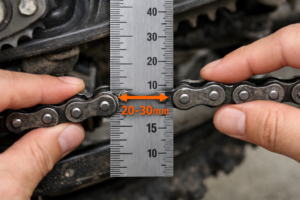
Step-by-Step Procedure for Checking Bike Chain Tension
The step-by-step procedure for checking the bike chain tension is outlined below:
Step 1 – Park On A Stable Surface
Use a stand to keep your bike balanced, or park it at a leveled ground. Tension changes when the suspension is pressed or when the rear wheel is lifted. Ensure that the suspension is resting before you check for tension.
Step 2 – Find The Midpoint of the Chain
Locate the midpoint of the chain between the front and rear sprockets. The midpoint indicates the chain’s effective working length while riding, thus it is the best point to measure slack from.
Step 3 – Push The Chain Up and Down
With the help of your fingers, slowly move the chain up and down at its midpoint. Count the total vertical movements, and that’s it, your chain slack is calculated.
Step 4 – Measure Total Movements
Using a ruler, tape, or a chain tension tool, determine the exact chain’s movement. Normally, the answer to the question of how much slack should a motorcycle chain have is that dirt bike slack ranges from 20-30 mm, but make sure to consider the manufacturer’s manual for accurate values.
Step 5 – Compare With Manufacturer Specifications
If the measured slack falls within the manufacturer’s specified range, then the chain is correctly adjusted. If the measurements fall outside the range, adjustments must be made using the rear axle and chain adjusters to adjust the chain correctly.
How to Adjust Dirt Bike Chain?
To adjust a dirt bike chain, loosen the rear axle nut, turn the adjuster bolts evenly on both sides, verify wheel alignment, and retighten to spec.
Tools Required
The tools you require for adjusting the dirt bike chain include:
- Wrench set
- Torque wrench
- Dirt bike chain tension tool
- Service manual
Step-by-Step: How to Adjust Dirt Bike Chain Properly
The step-by-step guide to answer how to tighten a dirt bike chain or adjust the dirt bike chain seamlessly is mentioned below:
Step 1 – Loosen the Rear Axle Nut
While using the right wrench, loosen the rear axle nut and allow the wheel to move.
Step 2 – Find the Motorcycle Chain Adjuster Bolts
Motorcycles have chain adjuster bolts usually located at the rear swingarm on both sides of the wheels. Find them and once found, move on to the next step.
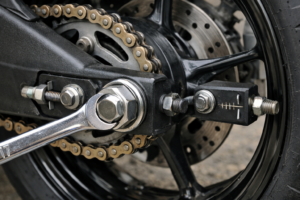
Step 3 – Turn Adjuster Bolts Evenly
Now turn the adjuster bolts equally to ensure that the wheel moves back and forward evenly, ensuring steady tension.
Step 4 – Inspect the Rear Wheel Alignment Marks
Verify if the alignment marks on both sides of the swingarm match. Take time to inspect thoroughly, as misalignment can contribute to an unbalanced chain.
Step 5 – Measure The Chain Slack Again
Once you have ensured that alignment marks on both sides match, you need to use a ruler or chain tension tool to ensure that the chain slack falls within manufacturer-approved range, i.e. 20-30 mm in most cases.
Step 6 – Tighten the Axle Nut
Now using a torque wrench, tighten the axle nut to prevent loosening while riding.
Common Adjustment Mistakes
The most common mistakes people make while adjusting the chain include:
- Adjusting only one side of the swingarm.
- Not torquing the rear axle nut.
- Missing measuring chain slack after tightening.
- Overlooking tight spots in the chain.
- Over-tightening the chain to add safety
Dirt Bike Chain Adjustment vs Replacement — How to Decide?
Through regular adjustment, riders can keep the dirt bike chain in its optimal conditions; however, if the chain does not fall within the manufacturer’s specified range or the sprocket teeth have been damaged then replacing the chain is necessary. Continuously attempting to adjust a damaged chain can contribute to unsafe riding and drivetrain damage.
Decision Table
A table guiding you on when to replace or adjust the chain is provided below:
| Condition | Action |
|---|---|
| Slack is slightly out of range | Adjust the dirt bike chain. |
| Uneven tight spots | Inspect closely |
| Elongation beyond spec | Replace chain |
| Hooked sprocket teeth | Replace full set |
How to Prevent Premature Wear After You Adjust Dirt Bike Chain?
Clean the chain with mild degreaser, lubricate every 300-500 km or after muddy rides, and inspect before every 1-2 rides to prevent premature wear. To prevent premature wear after adjusting the dirt bike chain, riders need to:
Implement Best Cleaning Practices
- Use a mild degreaser to clean the chain.
- Avoid using harsh chemicals that can damage the o-rings and other components.
Lubricate When Required
Riders should ensure that the chain is lubricated after:
- Muddy rides or
- Every 300-500 km, to prevent rust and reduce friction.
Service Schedule
Inspect the chain and other dirt bike parts for maintenance after every 1-2 rides or before the race. Timely maintenance can help you save on unnecessary maintenance costs and ensure safe and smooth rides.
What Is a Dirt Bike Chain Tensioner and When Should You Use One?
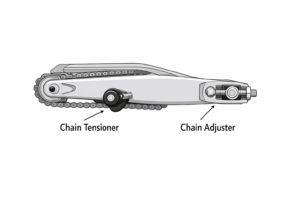
A dirt bike chain tensioner is a tool that holds the lower chain and manages slack while the bike is on rough terrain. In motocross bikes, the motorcycle chain tensioner guarantees steady delivery on off-road and rough terrains, but doesn’t take the place of chain adjustment.
Chain tensioners help when riding bumpy trails, where rapid chain movement can contribute to noise or cause the bike to get off the track.
| Recurso | Chain Adjuster | Dirt Bike Chain Tensioner |
|---|---|---|
| Localização | Rear axle | Braço oscilante |
| Function | Sets static slack | Controls dynamic movement |
| Adjustment | Manual | Passive |
What Is The 3 Finger Rule For Dirt Bike Chain?
The 3-finger rule is the simplest method that riders use to determine if the chain slack on a dirt bike is correct or not. To do this riders place three fingers (index, middle, and ring) between the chain and swingarm at the midpoint of the chain. If the chain touches their fingers without being too tight or loose, then the slack is in the safe range.
This method must only be used in case of emergencies, as the preferred option is to confirm with the manufacturer’s manual.
Perguntas frequentes
How To Check Chain Tension On A Dirt Bike?
To measure the chain tension on a dirt bike, measure the chain slack at the midpoint when the bike is on the stand. Use a ruler or a chain tension tool to check accurately.
How To Properly Adjust Chain Tension?
Loosen the rear axle, adjust the chain using the swingarm adjusters, while ensuring rear wheel alignment. Recheck the slack and tighten the axle nut.
How much slack should a motorcycle chain have?
Most dirt bikes require 20-30mm of chain slack measured at the midpoint. Street motorcycles typically need 25-35mm. Always check your owner’s manual for the exact specification.
How often should I check my dirt bike chain tension?
Check chain tension before every ride or at least every 1-2 rides. After muddy or wet conditions, inspect and clean the chain immediately.
What tools do I need to adjust dirt bike chain tension?
You need a wrench set for the axle nut, a torque wrench for proper tightening, and optionally a chain tension tool for precise measurement.
How do I know if my chain needs replacement instead of adjustment?
Replace the chain if it cannot be adjusted within spec, has stiff links, shows visible elongation, or if the sprocket teeth are hooked or worn.
Conclusion – Maintaining Proper Dirt Bike Chain Tension
Checking, adjusting, and maintaining the dirt bike chain tension is an easy but crucial task. A well-maintained dirt bike chain tension guarantees smooth power transfer. Make sure to check the chain slack regularly to enjoy an unforgettable riding experience.
For quality dirt bikes and OEM dirt bike parts, consider Bosuer, a Chinese off-road motorbike manufacturer with over two decades of experience and a high reputation for excellence.
 PT
PT  EN
EN  FR
FR  DE
DE  AR
AR  RU
RU  ES
ES  CN
CN