
TL;DR — Quick Answer First
- Most dirt bikes last 200–400 riding hours or around 3–10 years depending on maintenance and usage.
- 4-stroke engines usually last longer than 2-strokes under similar riding and service conditions.
- Proper oil changes, air filter care, and riding style strongly influence dirt bike lifespan.
- A used bike with high hours is not automatically bad — condition and service records matter more than mileage.
- Modern Chinese dirt bikes can deliver solid durability when maintained correctly
This guide covers dirt bike lifespan by hours, miles, and years, explains 2-stroke vs 4-stroke durability differences, and provides a buyer decision framework for evaluating used bikes. Written for buyers, beginners, and trail riders seeking practical, data-driven guidance on dirt bike longevity.
What Determines How Long a Dirt Bike Lasts?
The biggest factors behind how long do dirt bikes last are engine type, riding habits, maintenance quality, and build quality.
If riding is aggressive or maintenance is skipped, service life drops quickly.
Unlike street motorcycles, dirt bikes operate in dust, mud, vibration, and high load. That environment accelerates wear on moving parts. Two identical bikes can show very different engine health depending on care.
Primary lifespan drivers:
- Configuração do motor
- Oil change frequency
- Air filtration quality
- Cooling performance
- Riding terrain
- Throttle behavior
- Parts metallurgy
- Assembly quality
- Maintenance discipline
Major manufacturers such as Honda and Yamaha emphasize oil and air filter service as the top durability factors in their owner manuals:
Engine Type: 2-Stroke vs 4-Stroke
4-stroke engines usually provide longer intervals between rebuilds than 2 tempos engines.
Condition: If maintenance quality is equal, Motores de 4 tempos tend to produce longer total dirt bike life.
Many riders researching how many hours on a 4 stroke dirt bike is acceptable will find a wide range because use matters. Trail bikes last longer than race bikes.
2-stroke engines fire every revolution and operate with simpler internals, but top-end wear happens faster. The advantage is lower rebuild cost and simpler service.
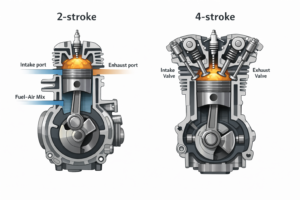
Lifespan Comparison Table
| Fator | 2 tempos | 4 tempos |
|---|---|---|
| Typical top-end interval | 80–150 hrs | 150–300 hrs |
| Typical total engine life | 200–300 hrs | 300–500 hrs |
| Rebuild cost | Mais baixo | Mais alto |
| Mechanical complexity | Mais baixo | Mais alto |
| Oil system | Fuel mix | Separate oil |
| Melhor para | Racing & light weight | Trail & endurance |
Manufacturer service interval references: KTM and Yamaha maintenance schedules
Quality of Parts, Brand Reputation, and Dirt Bike Lifespan
Higher-quality parts and stricter manufacturing standards typically result in longer dirt bike lifespan — but modern Chinese bikes have closed the durability gap for non-race use.
Japanese and European manufacturers are traditionally known for tighter machining tolerances and higher-grade alloys, which often translate into a longer average dirt bike lifespan. However, modern Chinese factory bikes have improved significantly in production quality and QC systems over recent years. As a result, durability gaps are smaller than they used to be — especially for non-race use.
Chinese dirt bikes are widely used in practical, lower-stress riding environments such as:
- Beginner training
- Recreational trail riding
- Farm and utility work
- Entry-level motocross practice
With correct oil changes, clean air filters, and proper chain service, Chinese bikes can produce dependable dirt bike lifespan results for non-race riders. While Japanese bikes generally average a longer lifespan due to higher baseline build standards, Chinese bikes can still deliver solid longevity when properly maintained.
How Many Hours Is a Lot for a Dirt Bike — and How Long Do Dirt Bikes Last in Miles and Years?
Dirt bikes are expected to last about 3–10 years or roughly 3,000–5,000 miles with proper care, but mileage alone is not a reliable measure of condition. Engine hours and maintenance history are far more important indicators of wear. Because dirt bikes are used off-road, distance tracking is often inconsistent, so engine hours are the preferred wear metric across the industry.
Generally, 250–400 hours is considered high for many dirt bikes, although this threshold can be reached much faster under aggressive riding than with light trail use. Riding conditions also change wear rates dramatically — for example, one mile on a deep sand track can create far more engine and drivetrain stress than one mile on a hardpack trail. That’s why service records, usage type, and runtime hours should always be evaluated together instead of relying on miles or age alone.

Hour-Based Condition Guide
| Engine Hours | Wear Level |
|---|---|
| 0–100 | Low |
| 100–200 | Moderado |
| 200–300 | Upper mid |
| 300–400 | High |
| 400+ | Very high |
A high-hour bike is not automatically a bad purchase — rebuild documentation changes the decision.
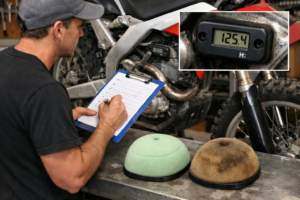
Using a Dirtbike Hour Meter
Answer: A Dirtbike hour meter tracks engine runtime and gives the best wear indicator.
Condition: If no meter exists, maintenance records become critical.
Why hours are better than miles:
- Off-road distance varies in load
- Idle time still causes wear
- Mud and sand increase stress
- Trail speeds vary widely
Racing organizations and mechanics commonly base service intervals on hours, not mileage.
Associação Americana de Motociclistas technical guidance:
Maintenance Tips to Extend Dirt Bike Engine Life
A dirt bike engine can run reliably for hundreds of hours when it’s maintained correctly. Many well-kept 4-stroke engines reach 400–500 hours before a major rebuild, but that level of lifespan depends on consistent servicing, controlled riding habits, and clean operating conditions.
Oil Changes Based on Engine Hours
Change oil according to engine hours and riding severity — hard riding and hot weather require shorter intervals. Fresh oil maintains lubrication and controls engine heat.
Replace or Clean Oil Filters Consistently
An old or clogged oil filter allows contaminants to circulate through the engine. Replace or properly clean the oil filter at every scheduled oil service. A clean filter protects internal components and slows long-term wear.
Use the Correct Oil Grade and Quality
Always use the oil type and grade recommended for your engine. Lower-quality oil can lose viscosity under heat and stress, reducing protection. Good oil is cheaper than engine repairs.
Maintain Proper Chain Tension
A chain that is too tight or too loose creates drivetrain stress and inefficient power transfer. Check chain slack regularly and adjust to specification. Correct tension reduces unnecessary load on transmission components.
Lubricate the Chain After Rides
Dust, sand, and mud quickly strip chain lubrication. Apply chain lube after rides — especially off-road sessions — to reduce friction and extend chain and sprocket life.
Replace Worn Sprockets Early
Hooked or sharp sprocket teeth are signs of wear. Replacing sprockets early prevents uneven chain wear and keeps drivetrain movement smooth and efficient.
Clean the Air Filter Frequently
Dirt bikes operate in dusty air, making air filter care critical. Clean the air filter after dusty rides to prevent debris from entering the engine and damaging internal parts.
Signs Your Dirt Bike Engine Is Worn Out
Dirt bike engines usually show warning signs before major failure. Watch for compression loss, hard starting, exhaust smoke, and knocking sounds — these are the most common signs of dirt bike engine wear.Recognizing these signals early allows you to schedule repairs or a rebuild before damage spreads and costs increase.
Loss of Compression
Reduced compression often shows up as weak starting and poor throttle response. It usually indicates piston, ring, or valve wear.
Hard Starting
If the bike becomes increasingly difficult to start despite correct fuel and spark, internal engine wear may be developing.
Excessive Exhaust Smoke
Blue or heavy smoke can signal oil burning inside the engine, often linked to worn rings or valve seals.
Knocking or Ticking Sounds
Unusual internal noises — knocking, ticking, or grinding — should never be ignored. These often point to mechanical wear or clearance issues.
Metal Particles in Engine Oil
Metal flakes found during an oil change are a strong warning sign of internal component wear and should trigger immediate inspection.
Perform Regular Compression Tests
A compression test provides a quick health snapshot of the cylinder and sealing components. Falling numbers over time indicate wear.
Use Leak-Down Testing for Deeper Diagnosis
Leak-down tests identify where pressure is escaping — through valves, rings, or gaskets — giving more precise diagnostic insight.
Inspect Oil During Every Change
Look closely at drained oil for discoloration, burnt smell, or metallic debris. Oil condition often reveals hidden engine problems early.
Check Valve Clearances on Schedule
Incorrect valve clearance leads to performance loss and long-term damage. Regular measurement and adjustment prevent premature wear.
What Is Considered High Mileage for a Dirt Bike?
High mileage for a dirt bike is generally considered to be around 4,000 miles or more, since most dirt bikes are built for performance and off-road stress rather than long-distance travel.
At this level, major components such as the piston, valves, clutch, and suspension are often significantly worn. However, mileage alone should not automatically disqualify a bike — if the owner can provide clear rebuild records, service logs, and proof of proper maintenance, a higher-mileage bike can still be a reliable and worthwhile purchase.
In such cases, documented engine rebuilds and regular servicing matter more than the odometer reading itself.
Always judge together:
- Hours
- Compressão
- Service history
- Visual wear
- Engine sound
Decision Framework: How to Judge Dirt Bike Lifespan Before Buying
To judge a dirt bike properly, use a structured checklist that combines engine hours, maintenance records, and physical inspection results rather than relying on mileage alone. Compare service history, rebuild proof, and wear on key components such as the engine, suspension, and drivetrain. If two bikes show similar hours of use, choose the one with clearly documented maintenance and verified service work, as records are a stronger reliability indicator than usage numbers by themselves.
Buyer Decision Table
| Fator | Good Choice | Risk Choice |
|---|---|---|
| Hours | Under 200 | Over 350 |
| Service records | Complete | Missing |
| Compressão | In spec | Unknown |
| Air filter condition | Clean | Dirty |
| Oil history | Frequent | Irregular |
| Engine noise | Smooth | Knocking |
Which Dirt Bike Will Last Longest for Your Riding Style?
| Rider Type | Motor | Maintenance Level | Expected Hours | Expected Years |
|---|---|---|---|---|
| Beginner trail | 4-stroke | Regular | 300–400 | 5–8 |
| Hobby rider | 4-stroke | Good | 350–500 | 6–9 |
| Racer | 4-stroke | Strict | 200–300 | 3–5 |
| Motocross | 2 tempos | Strict | 150–250 | 3–4 |
When Shouldn’t You Buy a High-Mileage Dirt Bike?
You should avoid high-hour dirt bikes that show structural damage or engine risk signs such as knocking sounds, metal in oil, frame cracks, or heavy compression loss. These indicators suggest costly repairs may be near even if the bike still runs. If your budget is limited, it is usually smarter to choose a lower-hour model in better mechanical condition rather than a cheaper high-hour bike with hidden risks.
5 Red Flags
- Rusted frame sections
- Bent forks
- Heavy exhaust smoke
- No maintenance proof
- Crash damage signs
Constraints — When Lifespan Estimates Do Not Apply
Standard lifespan estimates may not apply under extreme conditions — racing, deep sand, or skipped maintenance will shorten engine life significantly.
- If racing weekly → engine life shortens → choose race rebuild schedule
- If riding deep sand → wear increases → shorten oil interval
- If oil changes skipped → failure risk rises → avoid purchase
- If air filter neglected → engine damage risk → inspect intake
- If repeated overheating → rebuild sooner → choose trail model alternative
Perguntas frequentes
How many hours is normal for a used dirt bike?
A normal used dirt bike usually shows around 150–250 engine hours, which suggests moderate use without extreme wear.
How many miles is too many for a dirt bike?
More than 4,000 miles is generally considered high for a dirt bike, especially if there is no proof of engine rebuild or major service.
Does storage affect how long a dirt bike lasts?
Yes — keeping the bike dry, clean, and covered protects wiring, seals, and metal parts. Poor storage can shorten life even if the bike is not ridden much.
Is it better to rebuild a dirt bike engine or replace the bike?
If the frame and major parts are in good shape, rebuilding is often cheaper than buying another bike. Replacement makes more sense when multiple systems are worn out.
Does riding style really change dirt bike lifespan?
Very much — aggressive throttle, constant high RPM, and racing wear engines faster. Smooth trail riding usually adds many more usable hours to the bike.
Conclusão
Understanding how long do dirt bikes last comes down to engine type, maintenance discipline, and inspection data — not guesswork. Focus on hours, service records, and mechanical condition instead of mileage alone. Riders who follow strict oil, filter, and chain service schedules consistently achieve longer dirt bike lifespan results.
No Motor BSE, we are a Chinese dirt bike factory and manufacturer supplying durable off-road motorcycles with maintenance guidance and parts support to help maximize dirt bike life. Visit us to choose the right dirt bike for your needs.
 PT
PT  EN
EN  FR
FR  DE
DE  AR
AR  RU
RU  ES
ES  CN
CN