
Principais conclusões
- The difference between a pit bike and a dirt bike is wheel size, and wheel size decides how the machine behaves on rough ground more than engine capacity does.
- Our pit bikes use 14/12 and 17/14 wheel combinations, while our full-size dirt bikes use 21/18, and that gap changes how each machine crosses an obstacle.
- Measured seat height runs from 790 mm to 830 mm on our pit bikes and from 935 mm to 960 mm on our full-size machines.
- Wheelbase separates them too, at 1220 mm and 1260 mm for the pit bikes against 1460 mm and 1490 mm for the full-size models.
- Engine size is the secondary difference, because the small machines make 6.5 kW from 125cc while the full-size models make 16.5 kW and 35 kW.
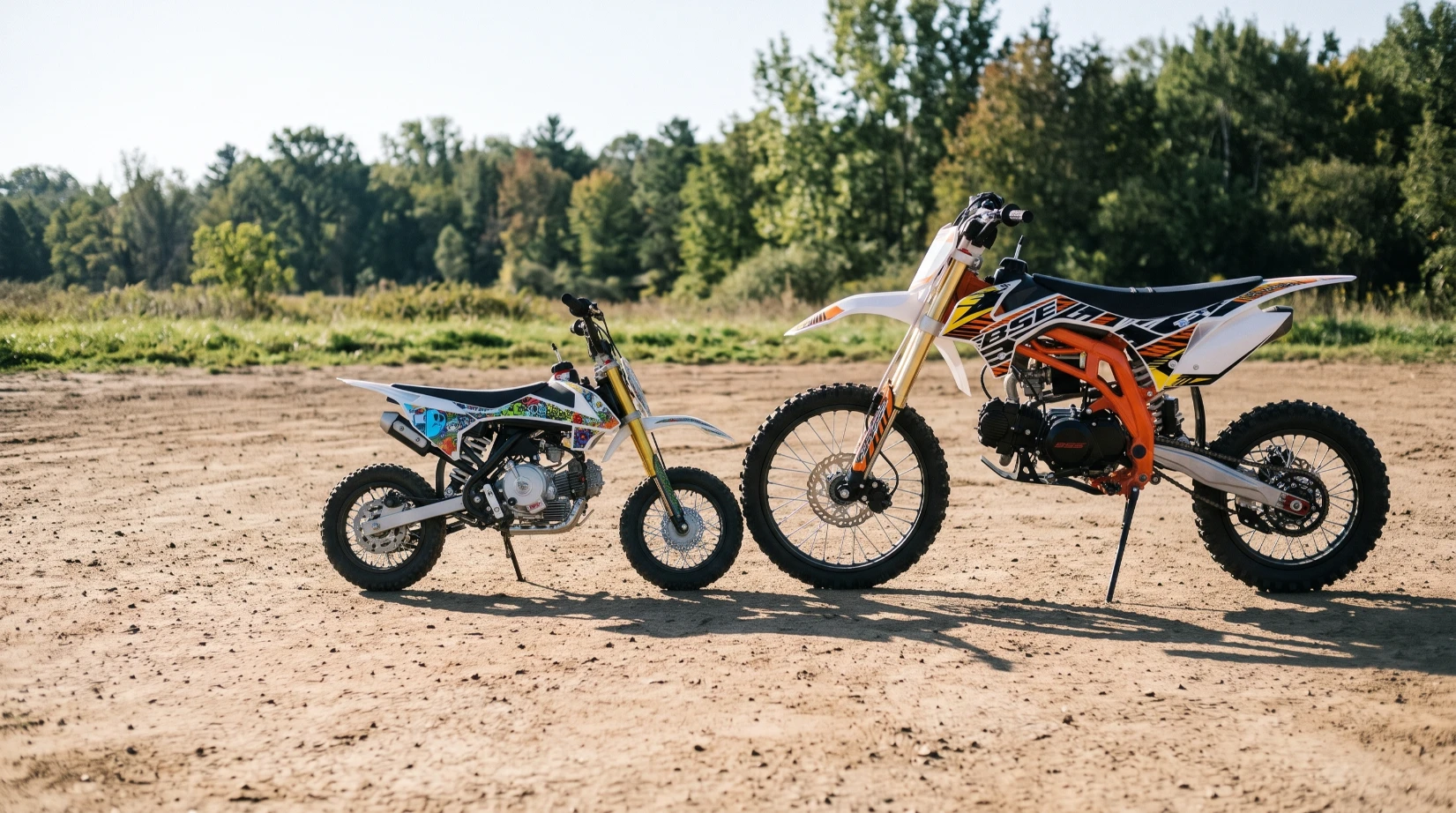
Most pit bike versus dirt bike comparisons begin with engine capacity, and that starting point hides the difference that riders actually feel. The two machines differ first in wheel size, and wheel size decides how a bike crosses a rock, a root and a rut before the engine ever becomes relevant. A smaller wheel drops further into a hole and climbs out at a steeper angle, which makes rough ground harder work and unsettles the chassis at lower speed. Therefore, the honest way to compare the two categories is to start with the wheels, the seat height and the wheelbase, and to treat the engine as the last question rather than the first. We measured all of those figures on our own machines, and the numbers below come from those measurements.
One note on naming, because the two terms get used loosely. A pit bike describes a small machine built around small wheels, and a dirt bike describes a full-size off-road motorcycle, and the categories overlap in price more than they overlap in capability.
Wheel Size Is the Real Difference
Wheel size is the real difference because it sets the angle at which the machine meets every obstacle, and that angle decides whether the bike rolls over or stops. Our pit bikes run 14/12 wheels on the PH05B and 17/14 on the PH10L, while our full-size dirt bikes run 21/18 on the X2 and X8. A 21-inch front wheel rolls over a root that a 14-inch wheel hits almost square, which means the rider on the smaller machine absorbs the impact instead of riding through it. Consequently, the wheel figures tell you more about where a machine belongs than any engine figure will. For example, a 14-inch front wheel meets a root at a much steeper angle than a 21-inch wheel, and the rider feels that difference in their arms rather than in the engine.
The same geometry explains why a small-wheeled machine feels nervous at speed on rough ground, and it is not a fault in the design. A shorter wheelbase and a smaller wheel reduce stability in a straight line over broken ground, and both of those are deliberate choices in a machine built for tight spaces. Our pit bikes run wheelbases of 1220 mm and 1260 mm, against 1460 mm and 1490 mm on the full-size models, so the difference in length is more than 200 mm. Therefore, a rider who wants to feel settled at speed needs the longer machine, and a rider who wants to turn inside a shed needs the shorter one. Similarly, the shorter machine is easier to load and store, which is a practical advantage that no specification sheet lists.
Seat height follows from wheel size rather than the other way around, because a taller wheel lifts the whole chassis. Our pit bikes measure 790 mm and 830 mm at the seat, and our full-size machines measure 935 mm on the X2, 940 mm on the X8 and 960 mm on the T300. Our youth machines sit lower again, at 570 mm on the KID 50 and 590 mm on the PH02S. In practice, that spread means the categories serve different riders rather than different preferences, and a rider who cannot reach the ground on a full-size machine should look at the smaller options before considering anything else. Consider a 1.6 m rider, because on a 960 mm seat that rider will not touch the ground comfortably and will avoid stopping on slopes as a result.
How the Two Compare
A measured comparison makes the categories easier to place than any description, because the figures line up in a consistent direction. Every dimension moves together, and that consistency is what identifies a machine’s purpose. Our pit bikes are lighter at 75 kg against 112 kg to 115 kg for the full-size models, and they are shorter and lower in every measurement we take. Therefore, the decision is not which machine is better but which set of figures matches the ground and the rider, and the table below sets both side by side.
| Measurement | Pitbike | Full-size dirt bike |
|---|---|---|
| Tamanho da roda | 14/12 (PH05B), 17/14 (PH10L) | 21/18 (X2, X8) |
| Altura do assento | 790 mm to 830 mm | 935 mm to 960 mm |
| Distância entre eixos | 1220 mm to 1260 mm | 1460 mm to 1490 mm |
| Massa em ordem de marcha | 75 kg | 112 kg to 115 kg |
| Saída | 6.5 kW from 125cc | 16.5 kW (X2 250cc), 35 kW (T300 300cc) |
| Youth machines for reference | 570 mm (KID 50), 590 mm (PH02S) | Not applicable |
Read the table by column rather than by row, because the direction of every figure matters more than any single value. A lighter, shorter, lower machine with smaller wheels behaves as one package, and a taller, longer, heavier machine behaves as another. Consequently, a rider who values one characteristic from each column will end up with a compromise that suits neither, and that is the most common mistake in this comparison. For example, a rider who wants the low seat of a pit bike and the stability of a full-size machine is describing a machine that does not exist.
Two figures deserve a specific note because buyers misread them most often. Kerb mass decides what happens after a fall, and the gap between 75 kg and 115 kg is the difference between a machine one person can lift and a machine that often needs two. Output decides how much the rider has to manage, and the gap between 6.5 kW and 35 kW is more than five times, which is a far larger difference than the wheel figures suggest. Therefore, check both against the rider’s strength and experience rather than against the price.
Who Each Is For
A pit bike suits a rider who values a low seat, a light machine and the ability to turn in a confined space, and who accepts less stability on rough ground. That combination suits a beginner building confidence on flat ground, a rider using a machine around a yard or a small property, and an adult who wants something to ride with children rather than ahead of them.In addition, the low seat and the light weight make the machine far easier to load into a van or a truck, which matters more than riders expect. Therefore, the category earns its place on convenience as much as on riding. In our experience, owners who keep a small machine alongside a larger one use the small machine more often than they predicted.
A full-size dirt bike suits a rider who covers distance on rough ground and needs the machine to stay settled at speed. The 21-inch front wheel rolls over obstacles that stop a smaller wheel, the longer wheelbase tracks straighter, and the taller seat gives the rider room to move their weight. Those properties matter most on long, rough terrain where the rider stands for extended periods. Consequently, a rider whose ground is open, broken and extensive will find the full-size machine easier to live with despite its weight.
The choice becomes clearer when you describe your typical session rather than your ambitions. A rider who rides an hour in a field or a yard gains nothing from a taller machine, and a rider who crosses a mountain gains little from a shorter one. In our experience, riders who write down where and how long they ride choose correctly, and riders who choose by appearance or by engine size usually trade within a season. That single sentence is worth more than any specification comparison.
Engine Size Is Secondary
Engine size is secondary because wheel size, weight and wheelbase already describe how a machine behaves, and capacity only describes how quickly it gets there. That said, the output difference between the categories is large enough to matter, so it belongs second rather than last. Our pit bikes produce 6.5 kW from 125cc, while our X2 produces 16.5 kW from 250cc and our T300 produces 35 kW from 300cc. Therefore, a rider moving between the categories will notice a change in output as well as a change in geometry, and the two together are what make the jump feel significant. In our experience, riders moving from a small machine to a full-size one are surprised by the geometry for the first hour and by the output for the first month.
Capacity within a single category tells you less than riders expect, and the reason is that tuning moves output substantially within one displacement. We measured six 250cc machines in our wider range between 10 kW and 26.5 kW, which is a spread of more than two and a half times from machines of identical size. An older 223cc design that the industry has used for more than twenty years produces only 12 to 13 kW, while our 300cc model makes 19.8 kW at 8500 rpm. Consequently, a rider comparing two 250cc machines should compare how the output arrives rather than how large the engines are. That distinction matters most to a beginner, who spends the first season at small throttle openings rather than at peak revs.
The practical test is to ride the machine slowly and watch how it behaves at small throttle openings, because that is where a beginner spends most of the first season. A machine that lurches from a closed throttle is harder to learn on than one that pulls smoothly, whatever the peak figure says. Then turn a slow figure of eight and notice whether the machine stalls or runs wide, because both reveal how the gearing and the delivery suit low-speed control. In our experience, those two tests predict how quickly a rider progresses better than any specification sheet.
Buying the Right One
Buy by the ground and the rider rather than by the category name, because the labels overlap and the specifications do not. Start with the wheel size, since it decides how the machine crosses obstacles, and then check seat height against the rider’s reach and kerb mass against their ability to lift the machine after a fall. Output comes after those three, because a rider who cannot control the machine at a standstill gains nothing from more power. Therefore, write the three figures down and compare models against them rather than against a price bracket.
Rider protection belongs in the same purchase, and the commission recommends a helmet and protective equipment at every ride while also advising riders to stay off paved public roads. That advice applies to both categories, and it applies to small machines as much as large ones, because a fall from a low seat onto hard ground is still a fall. In our experience, riders who buy gear with the machine ride more often in the first season, which is the outcome that matters most. Our guide to the mistakes beginners make covers the same ground for a first purchase.
Finally, confirm the physical fit in person rather than from a chart, and do it in riding boots. Sit the rider on the machine with an adult holding it upright and check that the balls of both feet reach the ground, then check the reach to the bar and levers. If a dealer will not allow that, treat it as information about the dealer. You can compare our full dirt bike range or read about dimensionando uma moto de motocross pelo peso Antes de decidir.
Perguntas frequentes
What is the difference between a pit bike and a dirt bike?
Wheel size, and everything that follows from it. Our pit bikes use 14/12 and 17/14 wheels with a 790 mm to 830 mm seat and a 1220 mm to 1260 mm wheelbase. Our full-size machines use 21/18 wheels with a 935 mm to 960 mm seat and a 1460 mm to 1490 mm wheelbase (BSE Motor, 2026).
Can an adult ride a pit bike?
Yes, and many do. A pit bike suits an adult who wants a light machine with a low seat for a yard, a small property or riding with children. The trade is stability on rough ground at speed, because the smaller wheels and shorter wheelbase move around more. Choose by the ground rather than by the category.
Are pit bikes easier to learn on?
The low seat and light weight help a beginner gain confidence, since the rider can reach the ground and the machine is easier to pick up. The smaller wheels make rough ground harder work, which can slow progress on uneven terrain. Start on flat ground and move to rougher surfaces as confidence builds.
How much does a pit bike weigh?
Our pit bikes weigh 75 kg, against 112 kg to 115 kg for our full-size dirt bikes. That gap decides what happens after a fall, since 75 kg is a machine one person can usually lift while 115 kg often needs two. Check the figure against the rider rather than against the category (CPSC, 2026).
Does wheel size really matter that much?
It matters more than most buyers expect. A 21-inch front wheel rolls over a root that a 14-inch wheel strikes almost square, so the rider on the smaller machine absorbs the impact. Wheel size also sets seat height, because a taller wheel lifts the whole chassis. Compare wheel size before engine capacity.
Conclusão
Three ideas settle this comparison. Start with wheel size, because it decides how the machine crosses obstacles and it sets the seat height that follows. Read the specifications by column rather than by row, since a lighter and shorter machine is a package that behaves differently in every situation. Then put engine size last, because output varies more within a capacity than it does between the two categories.
Seus próximos passos:
- Write down the ground you ride and how long a typical session lasts.
- Compare wheel size, seat height and wheelbase before engine capacity.
- Check kerb mass against whoever will lift the machine after a fall.
- Do the fit check in person, in riding boots, before you commit.
Continuar aprendendo
- Motocross bike sizes by weightWhy weight beats height for setup and class.
- Primeira moto de trilha: erros que iniciantes cometemAjuste, engrenagem, cilindrada e configuração.
- Melhorias importantes para motos de motocrossClassificado por efeito por unidade de custo.
- Confira nossa linha de motos off-roadModelos juvenis, de arena e em tamanho real.
Especificações dos modelos mencionados neste guia.
Os dados abaixo foram retirados da nossa própria documentação de produto (BSE Motor, 2026).
BSE KID — 60cc pit bike
- Seat height 570 mm
- Kerb mass 46 kg
- Wheelbase 920 mm
- 1.8 kW at 7,000 rpm, fully automatic
BSE PH05B — 125cc pit bike
- Altura do assento: 790 mm
- Peso em ordem de marcha: 75 kg
- Distância entre eixos: 1.220 mm
- 6,5 kW a 7.000 rpm, quatro marchas
Compare the wheel sizes
From 570 mm youth machines to 960 mm full-size models, with every fit figure published.
Veja motos de motocross →Referências
- Comissão de Segurança de Produtos de Consumo dos EUA. Segurança de veículos todo-terrenoAcesso em setembro de 2026.
- Comissão de Segurança de Produtos de Consumo dos EUA. Centro de Informações de Segurança para QuadriciclosAcessado em setembro de 2026 (CPSC, 2026).
Wheel size, seat height, wheelbase, kerb mass and output figures in this article were measured by our own engineering team on our own machines, so they are not independent laboratory results (BSE Motor, 2026). This article was written by Mojo and reviewed by our engineering team. You can read more about us on the site, or contact our team with questions about a specific model.
 PT
 EN
 FR
 DE
 AR
 RU
 ES
 CN