
Principais conclusões
– A pre-ride inspection takes 5–30 minutes and can prevent crashes, breakdowns, and costly repairs.
– Essential checks include tires, brakes, chain tension, suspension, fluid levels, and controls.
– Skipping grit levels, ignoring chain lubrication, and overlooking fluid levels are the most common inspection mistakes.
– Long rides and motocross events require additional preparation including spare parts and suspension adjustments.
– Always test the kill switch and inspect safety gear before every ride.
What This Article Covers
This guide provides a complete pre-ride bicicleta suja inspection checklist for beginners. It explains what to check, how to check it, and common mistakes to avoid. The article is written for new dirt bike riders, weekend trail riders, and anyone preparing for motocross events who wants to ride safely and maintain their bike properly.
Why Are Dirt Bike Checks Important Before Every Ride?
A dirt bike is constructed in order to withstand harsh environments. It struggles against mud, dust, rocks, jumps and top speeds. Due to that, its components break down sooner than ordinary street motorcycles. Loose bolts, worn-out parts, low fluid levels, and damaged parts can be identified in a short pre-ride inspection before they turn into issues.
Pre-ride checks help you:
- Reduce the risk of crashes
- Prevent unexpected breakdowns
- Save money on repairs
- Maintain strong engine performance
- Extend the overall lifespan of your bike
This is especially important for beginners who may not yet recognize early warning signs. It is also critical if your bike is new, recently serviced, or used for long off-road trips.
Common Problems Riders Face Without Pre-Ride Checks
Without regular inspections, riders commonly experience brake failure, chain derailment, engine overheating, and tire blowouts—all of which can cause serious accidents.
Without regular inspections, riders commonly face:
Brake failure: Worn pads or low fluid increase stopping distance, especially dangerous on dirt tracks.
Chain derailment: A loose or dry chain can jump off the sprocket and seize the rear wheel at high speed.
Engine overheating: Low oil or coolant causes excessive heat, leading to piston damage or complete engine failure.
Tire blowouts: Underinflated tires with worn tread or sidewall cracks fail easily on rocky terrain.
Electrical failures: A faulty kill switch or loose wiring can cause the engine to stall unexpectedly.
Fuel system problems: Leaking or clogged fuel lines cause hesitation, stalling, or leave you stranded.
Decision Table: Quick vs Detailed Pre Ride Inspection
| Inspection Type | Time Required | Items Checked | Recommended For |
|---|---|---|---|
| Quick Check | 5–10 minutes | Tires, brakes, chain | Short daily rides |
| Full Checklist | 20–30 minutes | Tires, brakes, chain, suspension, fluids, cables, safety gear | Long rides, off-road trips, motocross events |
What Should Be Included in a Complete Bike Ride Checklist?
A complete pre-ride checklist covers seven key areas: tires, brakes, chain, suspension, fluids, controls, and safety gear.
Step 1: Tires and Wheels
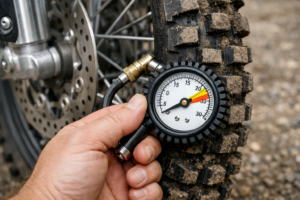
Start with the tires. Check tire pressure with an honest gauge because the right pressure will guarantee stability and traction. Now, look at the tread carefully. Make sure that it is not mangled up or that there are no pointed bits like nails or little pebbles.
Step 2: Brakes and Levers
Then move on to the braking system, where the hydraulic brake fluid that is available in both front and rear reservoirs should be inspected. Check the brake pads, they should be thick enough because thin brake pads reduce braking power. Squeeze the two brake levers confidently to ensure that they are firm and sensitive. The system can be air-pressurized, or it may have a leak. In either case, the lever may feel soft or move too much.
Step 3: Chain and Sprockets
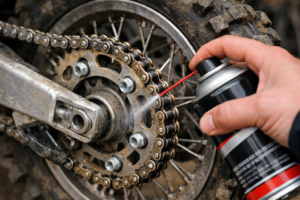
Take a closer look at drive chain. Check the slack of the chain according to the instructions of the manufacturer. A chain that is too tight may damage bearings, while one that is too loose may jump off the sprocket. Wipe and grease the chain. Check the sprockers with sharp or worn teeth. Over wear minimizes performance and may destroy the chain.
Step 4: Suspension and Steering
Look at the front forks of the bike and see whether they have oil leaks around the seals. Check the rear shock absorber to be sure that it rebounds and compresses. Get the bike and sit on it bouncing it slightly to ensure the suspension moves. Rotate the handlebars clockwise and counterclockwise to confirm that there is smooth steering.
Step 5: Fluids and Fuel
Measure the level of engine oil using the dipstick or the sight glass. The oil is supposed to be clean and at the required level. In the case of an oil-cooled bike, inspect the coolant tank. Make sure there are no leaks.
Be sure also that there is sufficient petrol in the fuel tank to take you through your intended ride. Look at the fuel lines to check whether they are broken or loose. Proper service intervals and specifications are available in official manuals of manufactures like Honda, Yamaha or KTM.
Step 6: Controls and Cables
Turn the throttle slowly to ensure it returns smoothly and does not stick. Regulate the tension of the clutch cable such that it slides easily. Inspect the brake and clutch levers for cracks or bent. Check lights, horn (where fitted) and kill switch to ensure that they are functioning properly.
Step 7: Safety Gear Check
Lastly, examine your personal protective gears. Ensure that you put on a helmet that fits well and is free of any holes. Gloves must provide you with a good grip. You should wear boots to cover your ankles. Wear body armors and goggles in order to be safe. The adherence to the safety guidelines provided by the Department of Transportation and safety recommendations by the organizations like the Associação Americana de Motociclistas may do even more to make motorcycle riders safer.
How to Adapt the Checklist for Long Rides or Motocross Events?
Long rides and motocross events require additional preparation including spare parts, tire repair kits, and suspension adjustments for track conditions.
Pre-Race Checklist Additions
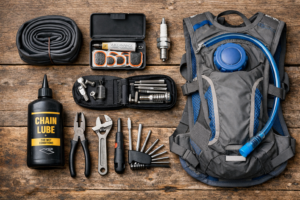
For competitive or extended rides, consider carrying:
- Spare inner tubes
- Tire repair kit
- Extra chain lubricant
- Basic tool kit
- Spare spark plug
- Hydration pack
This ensures minor problems do not end your ride early.
Adjusting Suspension and Tire Pressure for Track Conditions
Track conditions change daily. Soft sand requires lower tire pressure for better grip. Hard-packed tracks may need slightly higher pressure. Suspension settings can be adjusted for jumps or rough terrain. Proper setup reduces fatigue and improves control.
Common Mistakes Riders Make During Pre Ride Inspections
The most common inspection mistakes include rushing the process, skipping chain lubrication, ignoring fluid levels, and not testing the kill switch.
Rushing Through the Process
One of the common mistakes is the hurry of checking the bike. Riders can look at the bike and do not check the brakes of the test, the movement of the handlebar, or the display of the gauge of the tires. Checking This should include checks (tapping, pressing, confirmation) of every component being functional. Accuracy should not be superseded with speed.
Ignoring Chain Lubrication
A number of riders change the chain tension but forget about lubrication. A dry chain increases friction, produces excessive heat and is easily worn out. In the long run, this damage to the chain and sprockets may lead to expensive replacements.
Overlooking Tire Cracks or Low Pressure
Tires might be fine at the distance, but the tiny cracks or latent punctures on the sidewall can make them weak. Incorrect tire pressure disrupts the balance, braking, and cornering performance. Many riders estimate pressure by feel instead of using a gauge, which is dangerous.
Forgetting Fluid Levels
The level of oil and coolant always remains unnoticed since the leaks are not always visible. When the bike starts normally, the riders tend to believe that nothing is wrong. However, the fact is that an engine can be damaged gradually even when the engine is running out of oil or coolant, but without any obvious signs.
Skipping Electrical and Kill Switch Tests
Most riders do not check the kill switch and other electric controls. When the kill switch malfunctions in an emergency, then it may put the situation in a risky position. Always test it before riding.
Perguntas frequentes
What is the 12-second rule for motorcycles?
The 12-second rule means doing a very quick visual and physical check of your bike and gear before starting. In a few seconds, confirm brakes feel firm, tires look properly inflated, and controls move freely.
How to check dirt bike before buying?
Check tire condition, brake system, suspension, engine performance, and service history. Look for crash evidence and oil leaks. During a test ride, listen for unusual engine sounds and feel for smooth throttle and brake response.
What to check on a motorcycle before riding?
Use a complete pre-ride inspection checklist covering tires, brakes, chain, suspension, fluids, controls, and safety gear.
How often should I do a full dirt bike maintenance check?
A maintenance inspection needs to be performed every 20 to 30 hours of riding time or once a month according to the rider’s schedule and the current state of the riding trails.
Conclusão
Dirt bikes can be checked properly during pre-riding; however, it is a must. It protects your life, economizes on expensive repairs and also improves the performance of your ride. This is a habit that new riders should pick up and continue with it. Although dirt biking is an exciting activity, it should be safe.
Em Motor BSE, we manufacture dirt bikes to high quality and performance. We will take our customers on a maintenance and pre-ride check to ensure that they have a secure ride.
 PT
PT  EN
EN  FR
FR  DE
DE  AR
AR  RU
RU  ES
ES  CN
CN