
Resumindo:
- The most common causes of 2 stroke engine bogging — during acceleration, at full throttle, or under load — trace back to carburetor tuning, fuel delivery, or air-fuel mixture imbalance.
- If the engine only runs on choke, it confirms a lean condition caused by insufficient fuel or air leaks.
- A structured 6-step diagnosis (fuel → air → spark → carburetor → seals → mechanical) resolves most bogging issues without expensive repairs.
- Carburetor cleaning and jet adjustment fix the majority of bogging cases.
- Persistent bogging after basic checks indicates internal mechanical issues that require professional diagnosis.
This guide walks DIY riders, mechanics, and equipment owners through each diagnostic step for bogging 2 stroke engines — covering dirt bikes, chainsaws, outboard motors, and similar 2-stroke applications.
How to Identify a Bogging 2 Stroke Engine?
A bogging 2 stroke engine shows hesitation, stumbling, or sudden power loss — most noticeably when the throttle is applied or under load..
If the machine runs smoothly at idle but struggles when the throttle is applied, the issue is usually related to fuel delivery, carburetor tuning, or airflow imbalance.
When Does Bogging Occur?
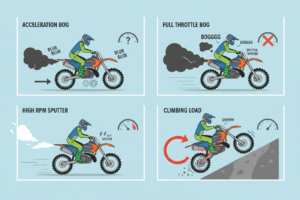
Understanding when a 2 stroke engine bogs helps quickly identify the root cause. There are several common scenarios, including:
- Bogging when accelerating
The engine hesitates or stumbles as the throttle is applied. This is one of the most common issues and is often linked to carburetor tuning or fuel supply problems. - Bogging at full throttle
The engine fails to maintain high RPM under load. This condition is commonly referred to as 2 stroke bogging at wide open throttle. - Sputtering at high RPM
Irregular combustion at higher speeds indicates 2 stroke bogging at high rpm. - The engine struggles under load.
When the engine is working harder, such as during climbing or heavy operation, it may experience 2 stroke bogging under load. - Runs only on choke
This condition clearly indicates a lean mixture problem, often described as 2 stroke only runs on choke
What These Symptoms Indicate?
These symptoms typically point to issues in one or more of six systems: fuel delivery, air intake, ignition, carburetor, seals, or internal mechanical components. The following step-by-step guide diagnoses each system in order of likelihood.
How To Diagnose And Fix A Bogging 2 Stroke Engine
Most 2 stroke bogging issues can be resolved by working through six systems in order: fuel, air intake, ignition, carburetor, seals, and mechanical components. The table below helps identify the most likely starting point based on symptoms.
| If your engine… | Most likely cause | Start at |
| Hesitates or stumbles on acceleration | Fuel delivery issue | Step 1 |
| Feels restricted, poor response across all RPMs | Airflow blockage | Step 2 |
| Misfires or runs unevenly | Spark / ignition fault | Step 3 |
| Bogs at full throttle or under load | Carburetor jetting or blockage | Step 4 |
| Only runs on choke, idles high or surges | Air leak (lean condition) | Step 5 |
| Still bogs after all above checks pass | Internal mechanical issue | Step 6 |
Step 1: Fuel System
A fuel delivery problem is the most common reason a 2 stroke engine bogs when the throttle is applied. If the engine runs fine at idle but hesitates during acceleration, start here.
Check:
- Check whether the fuel is old, stale, or contaminated with dirt or water.
- Verify the correct 2 stroke premix ratio according to the manufacturer’s specifications.
- Inspect fuel lines for cracks, kinks, or internal blockage.
- Ensure fuel flows freely from the tank to the carburetor without interruption.
Confirm:
- The engine hesitates or loses power as the throttle is applied, but recovers at idle.
- RPM drops suddenly during acceleration, indicating fuel starvation.
Fix:
- Drain and replace old or contaminated fuel with a fresh, correctly mixed batch using the recommended 2 stroke fuel mixture ratio.
- Replace the fuel filter if it is clogged or discolored.
- Clean or replace fuel lines to remove internal deposits and restore full flow.
Step 2: Air Intake System
Restricted airflow causes an over-rich condition that leads to 2 stroke engine bogging, particularly under load or sustained acceleration.
Check:
- Inspect the air filter for dirt, oil saturation, or physical damage.
- Examine the intake path for debris or obstructions.
- Verify that all intake connections and boots are properly sealed.
Confirm:
- The engine feels choked and struggles to reach higher RPM levels, even with a clean fuel system.
- Throttle response is noticeably sluggish across all speed ranges.
Fix:
- Clean or replace the air filter based on its condition.
- Clear any debris from the intake tract.
- Inspect and repair any cracks or loose connections in the intake manifold.
Step 3: Spark / Ignition System
Weak or inconsistent spark causes incomplete combustion, leading to misfires and 2 stroke engine bogging during acceleration or under load.
Check:
- Remove the spark plug and inspect for carbon fouling, wet fuel deposits, or electrode erosion.
- Measure the spark plug gap and compare it to the manufacturer’s specification.
- Inspect the ignition coil and spark lead for damage, corrosion, or loose connections.
Confirm:
- The engine misfires or hesitates irregularly, rather than consistently at one throttle position.
- RPM is unstable and the engine may stall under load.
Fix:
- Replace the spark plug with a new one of the correct heat range.
- Set the electrode gap to the manufacturer’s specification.
- Inspect the ignition coil and replace it if spark output is weak or intermittent.
- Clean and securely reconnect all ignition wiring.
Step 4: Carburetor (Most Common Cause)
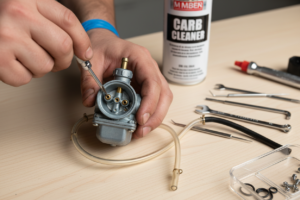
The carburetor controls the precise air-fuel mixture for combustion, and internal blockage or incorrect jetting is the single most common cause of 2 stroke engine bogging — especially bogging at full throttle or 2 stroke bogging at wide open throttle.
Check:
- Inspect the carburetor body for dirt buildup and varnish deposits.
- Remove and examine the main jet and pilot jet for partial or full blockage.
- Verify that all internal fuel passages are clear.
Confirm:
- The engine bogs specifically when the throttle is opened quickly or held at high RPM.
- Performance is uneven across different RPM ranges, with noticeable flat spots.
Fix:
- Disassemble the carburetor and clean all components thoroughly using a dedicated carburetor cleaning solution.
- Clear every jet and passage with compressed air or fine wire.
- Replace worn gaskets, needles, or seats using a 2 stroke carburetor rebuild kit.
- Perform a carburetor adjustment: set the low-speed screw for smooth idle and consistent initial throttle response, then adjust the high-speed screw for stable power delivery at full throttle and under load.
Step 5: Air Leaks
Unmetered air entering the engine bypasses the carburetor and creates a lean condition, causing erratic idle, overheating, and 2 stroke engine bogging that worsens under load. If the engine only runs on choke, an air leak is the most likely cause.
Check:
- Inspect the intake gasket for cracks, warping, or deterioration.
- Examine crank seals for wear or visible leakage.
- Check all intake manifold connections for gaps or loose fittings.
Confirm:
- The engine idles high, surges, or hunts without throttle input.
- Performance temporarily improves when the choke is partially engaged — a classic sign of a 2 stroke that only runs on choke.
Fix:
- Perform a 2 stroke intake leak test using a vacuum gauge or a spray method (carburetor cleaner sprayed around gasket surfaces while the engine is running — a rise in RPM confirms a leak at that location).
- Replace any damaged intake gaskets, crank seals, or manifold components.
- Reassemble and torque all fittings to specification to ensure a complete seal.
Step 6: Mechanical Issues
Internal mechanical faults are the least common but most serious cause of 2 stroke engine bogging. If all fuel, air, ignition, carburetor, and seal checks have been completed without resolving the problem, the issue is likely mechanical.
Check:
- Inspect reed valves for cracks, chips, warping, or failure to seat properly.
- Examine the exhaust port and pipe for heavy carbon buildup or blockage.
Confirm:
- The engine shows persistent power loss and poor throttle response despite correct carburetor settings, fresh fuel, good spark, and no air leaks.
Fix:
- Replace damaged or worn reed valves.
- Decarbonize the exhaust port, power valve (if equipped), and exhaust pipe to restore proper gas flow.
Quick Troubleshooting Table
| Symptom | Likely Cause | Quick Fix |
| Bogging on acceleration | Fuel delivery or carburetor issue | Clean carburetor, check fuel lines and filter |
| Runs only on choke | Lean mixture or air leak | Perform intake leak test, replace seals |
| Bogging at full throttle | Incorrect main jet or fuel starvation | Re-jet or clean main jet |
| Sputtering at high RPM | Restricted fuel flow | Replace fuel filter, inspect fuel lines |
| Engine dies when throttle is applied | Dirty carburetor or weak spark | Clean carburetor, replace spark plug |
When NOT to DIY?
If the engine shows low compression, damaged crank seals, or persistent bogging after completing all basic checks, the problem requires professional repair. These cases include:
- Low compression prevents proper combustion and requires internal component repair.
- A damaged crank seal can create a major air leak that can cause a lean condition and unstable performance. Replacing the crank seal often requires partial engine disassembly.
- Overheating, metallic knocking, or unusual engine noise indicates severe lean running, internal damage, or lubrication failure. Continuing to operate the engine without fixing it can worsen the damage.
- If the engine shows bogging when accelerating, bogging at full throttle, or continues to lose power after checking air, fuel, ignition, and carburetor settings, the issue may require deeper mechanical fault diagnosis.
In these situations, it is better to consult a certified technician or follow the repair procedures suggested by SAE International.
How to Prevent Bogging in a 2 stroke Engine?
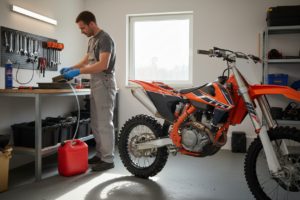
Regular maintenance — particularly carburetor cleaning, fresh fuel, and air filter upkeep — prevents most 2 stroke bogging issues. Other effective tips to prevent bogging include:
- Cleaning the carburetor regularly
- Using fresh fuel
- Maintaining the correct fuel mixture ratio.
- Keeping the air filter clean
- Checking the spark plug regularly
- Removing carbon buildup from the exhaust system
Perguntas frequentes
How do I know if my 2 stroke is running lean or rich?
A lean-running 2 stroke overheats, hesitates on acceleration, and may only run with the choke on. A rich-running engine produces excessive smoke, fouls spark plugs, and sounds rough at idle. Checking the spark plug color is the fastest way to confirm: tan/light brown indicates correct mixture, white indicates lean, and dark black indicates rich.
Does bogging mean lean or rich?
Bogging can indicate either condition. A lean bog causes hesitation and overheating, especially during acceleration. A rich bog causes sluggish throttle response and excessive exhaust smoke. Check the spark plug — a white electrode suggests lean, a black or wet electrode suggests rich.
What does a rich bog sound like?
A rich bog produces a deep, rough, gurgling sound, often accompanied by black or heavy exhaust smoke. The engine feels sluggish and unresponsive, as if it is choking on excess fuel.
Why does a 2 stroke bog at full throttle?
A 2 stroke bogs at full throttle when the main jet is too small, partially blocked, or when fuel flow cannot keep up with engine demand. Check the main jet for blockage, verify fuel line flow, and ensure the fuel filter is clean.
Partner with BSE Motors Today
Bogging can reduce engine power and affect performance; however, it can be diagnosed, fixed, and prevented easily. BSE Motors is a leading Chinese manufacturer specializing in high-performance off-road motorcycles and dirt bikes.
With strong research and development capabilities and an experienced team, BSE Motors delivers reliable and durable products to the global market. Get to know more about us by contacting us today.
 PT
PT  EN
EN  FR
FR  DE
DE  AR
AR  RU
RU  ES
ES  CN
CN