
Основные выводы
- Annual DIY maintenance costs $150-300; dealer service runs $400-800. Either way, it beats a $1,500-3,000 engine rebuild.
- ATVs maintained on schedule last 10-15 years or 200-400+ riding hours; neglected machines fail in 3-5 years.
- Chinese-brand ATVs follow the same principles but need more frequent fastener checks and specific parts sourcing.
- A consistent maintenance log adds 10-15% to resale value.
Why Maintenance Matters — And What Skipping It Costs
A neglected air filter can score cylinder walls in under 50 hours of dusty riding. That turns a $30 replacement part into a $1,500 engine rebuild. Fleet data from Carnee Trains (2026) puts the ratio at roughly 1 to 8: every dollar of preventative maintenance saves about eight dollars in reactive repairs. An engine rebuild runs $1,500-3,000. A CVT belt inspected at 100 hours is a $75 check. A broken belt on the trail can damage the clutch housing and leave you stranded miles from help.
Beyond cost, safety is the main reason to stay on schedule. Brake failure from contaminated fluid, steering components that seize from ungreased joints, tire blowouts from incorrect pressure — these are all preventable with routine inspection. The lifespan gap bears repeating: machines on proper schedules last 10-15 years or 200-400+ riding hours. Machines that get neglected often fail catastrophically inside 5 years.
The ATV Maintenance Schedule at a Glance
The most practical way to organize ATV maintenance is by operating hours rather than calendar time. Honda, Polaris, Yamaha, and most Chinese OEMs converge on a similar set of intervals. LookOver’s 2025-2026 analysis of aggregate manufacturer data puts the baseline at oil changes every 50 hours or 6 months, air filter checks every 10-25 hours in normal conditions, and coolant flushes every 2 years or 200 hours.
The table below covers the full range from pre-ride checks to major service. Bookmark this section if you bookmark nothing else.
| Frequency | Tasks | Уровень квалификации |
|---|---|---|
| Pre-Ride (5 min) | Check tire pressure, oil level, coolant, brakes, throttle, lights, chain tension | Easy |
| Every 10h / Weekly | Lubricate chain, check air filter (dusty conditions), inspect tire tread | Easy |
| Every 25h / Monthly | Inspect battery terminals, check brake pad thickness, inspect CV boots, clean air filter | Easy-Moderate |
| Every 50h / 6 Months | Change engine oil + filter, replace/clean air filter, grease all zerks, check spark plug | Умеренный |
| Every 100h / Annually | Replace spark plugs, flush coolant, change diff/gear oil, inspect CVT belt | Умеренный |
| Every 200h / 2 Years | Flush brake fluid, replace wheel bearings, inspect suspension bushings, valve clearance check | Professional |
Roughly 60% of these tasks are straightforward enough for any owner to handle with basic tools. About 25% require moderate mechanical experience. The remaining 15% — engine work, transmission repairs, valve adjustments — are best left to a professional.
See also: What Are the Different Types of ATVs? — the right schedule depends partly on what kind of machine you’re running.
Your Pre-Ride Inspection Checklist
Before every ride, spend five minutes on a routine that can prevent most trail-side breakdowns. Fleet operators who run this checklist catch problems early — a loose axle nut, a low coolant level, a brake line rubbing against the frame — before they turn into tow bills.
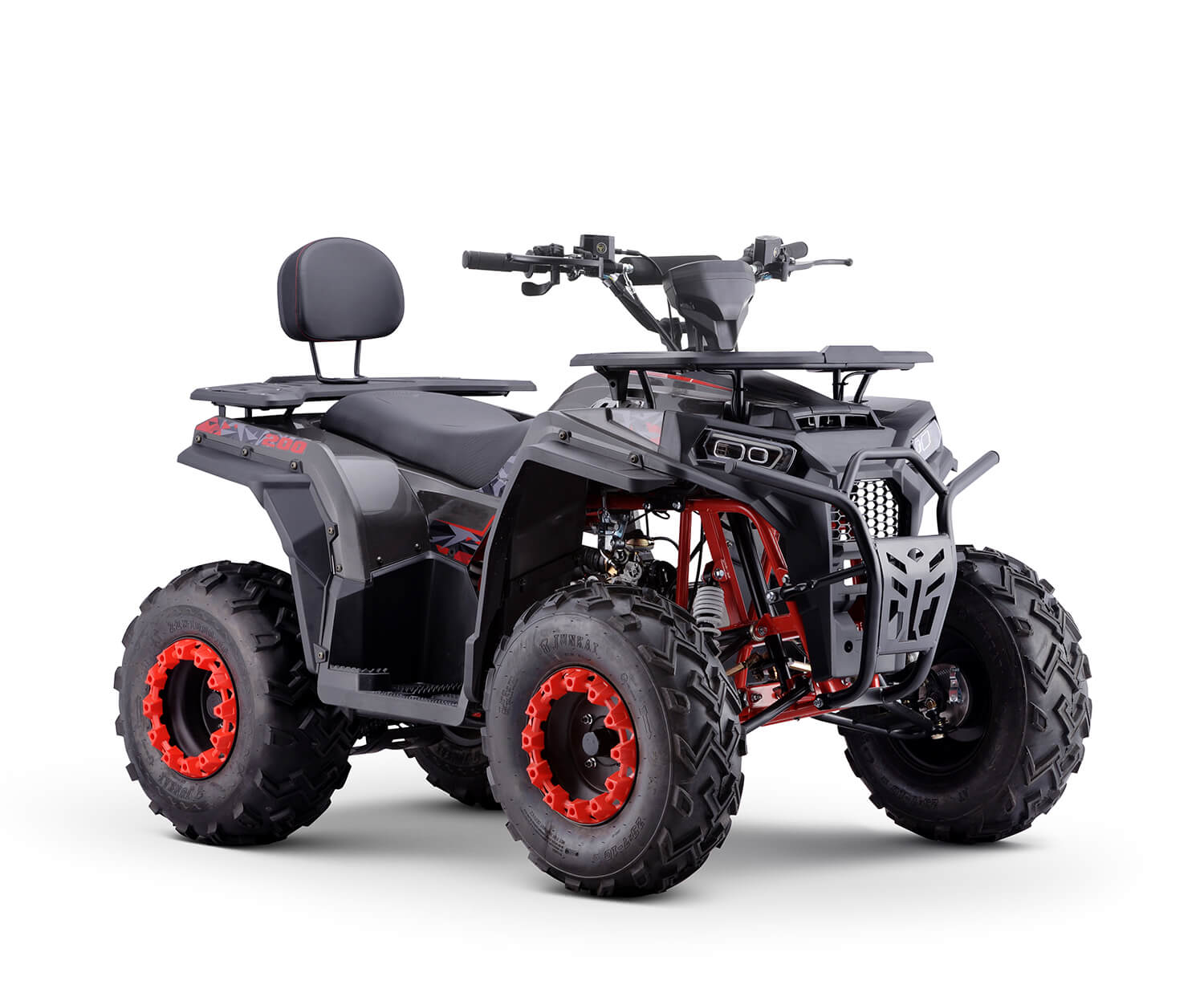
Work through these eight checks in order:
- Шины — Check pressure with a gauge (4-7 psi for off-road, 10-14 psi for utility). Look for cuts, embedded debris, and uneven tread wear.
- Engine oil — Engine cold, check the dipstick or sight glass. Top off if low. Milky oil means a coolant leak — do not ride.
- Coolant — Verify the reservoir is between min and max lines. Low coolant is the top cause of trail-side overheating.
- Brakes — Squeeze each lever. Firm feel is normal. Spongy means air in the line or low fluid.
- Throttle — Twist and release. It should snap back freely. Sticky means cable service is due.
- Lights & signals — Brake light, headlight, turn signals. Legally required on public roads in most jurisdictions.
- Chain or belt — Check tension (1-2 inches of slack for chain drive). Look for rust, kinked links, or fraying.
- Steering — Turn handlebars lock to lock. Check for smooth operation and tight fasteners.
Related: How to Read ATV Tire Sizes — choosing the right rubber starts with understanding the markings.
Engine Oil and Filter: When and How to Change Them
Neglecting oil changes is the single most common cause of premature engine failure. The specific mistake that keeps showing up: using automotive oil in an ATV with a wet clutch. Carnee Trains (2026) notes that automotive oils contain friction modifiers that cause clutch slip within 200 miles. ATVs need JASO MA or MA2 rated motorcycle oil — the difference matters at the clutch plates, not just the spec sheet.
Oil loses its protective properties gradually, not suddenly. Under normal recreational riding, viscosity retention drops to roughly 50% by 50 hours — the point where metal-on-metal contact becomes a real concern. Under heavy use (farm work, dunes, mudding), degradation accelerates, reaching that same threshold by about 30 hours. The chart below illustrates this trend. Specific percentages are indicative, not precise, since actual oil life varies by brand, formulation, and engine design.
Changing the oil takes about 30 minutes:
Warm up the engine for 2-3 minutes — hot oil drains faster and carries more contaminants out with it. Put a catch pan under the drain plug, remove the plug, and let everything drain for 5-10 minutes. Replace the crush washer if your machine has one.
Unscrew the old oil filter. Before installing the new one, apply a thin film of fresh oil to the gasket. Hand-tighten plus three-quarters of a turn. Overtightening is a surprisingly common mistake that strips the filter housing threads.
Refill with JASO MA or MA2 rated oil at the viscosity your manual specifies — 10W-40 is the most common across ATV models. Fill slowly and check the dipstick as you go. Once full, start the engine and let it idle for 30 seconds. Check around the drain plug and filter for leaks, then shut off and recheck the oil level.
Air Filter: The Most Overlooked Critical Component
A dirty air filter kills engines faster than almost any other maintenance failure. In dusty trail conditions — the kind where you can see a roost behind the rider in front of you — BoostATV (2023) recommends checking the filter after every ride, roughly every 5-10 hours. Under normal conditions, every 10-25 hours is sufficient.
Dirt that gets past a clogged or damaged filter doesn’t disappear. It acts as grinding paste on cylinder walls, piston rings, and valve seats. By the time you notice a power drop, the damage is already done.
Three types of ATV air filters, with different care requirements:
Foam filters are the most common on Chinese ATVs and sport models. They are washable and reusable. Clean them with filter-specific solvent, let them dry completely, and re-oil with foam filter oil. One important detail: never wring or twist foam to dry it — this tears the cell structure and creates channels for dirt to pass through.
Paper filters are typical on utility ATVs from Polaris, Honda, and Yamaha. Tap loose dirt out and replace the filter when it looks dirty. Do not wash paper filters. Do not blow them out with compressed air — that damages the filter media and creates holes that let dirt through.
Oil foam filters are pre-oiled performance units. Clean with dedicated spray cleaner and re-oil with the kit’s spray oil.
The one warning that matters: if you open the airbox and see visible dust inside the intake tract, your filter or its seal has failed. Dust in the intake means the engine is being sandblasted. Stop riding and replace the filter immediately.
Cooling System and Brakes
Overheating is the second most common cause of engine failure after oil neglect. The typical interval for liquid-cooled ATVs is a coolant flush every 2 years or 200 hours, per Polaris OEM guidelines (2026). After that point, the corrosion inhibitors in the coolant break down, which leads to water pump failure, clogged radiator passages, and eventually head gasket failure.
Coolant upkeep is straightforward: check the reservoir level before every ride. Use the coolant type your manual specifies (usually ethylene glycol-based, 50/50 with distilled water). Inspect the radiator fins for mud packing — clean them carefully with a fin comb, not a pressure washer. Replace the radiator cap every 2 years; a failing cap loses pressure and lowers the coolant’s boiling point.
Brake fluid follows a similar timeline. CarParts.com (2025) explains that brake fluid absorbs moisture from the air over time. That moisture lowers the fluid’s boiling point, which causes brake fade on long descents. Flush the fluid every 2 years regardless of miles or hours ridden. Inspect brake pad material at 25-hour intervals and replace pads when they wear below 2 mm.
After mud riding: pressure-wash the undercarriage and suspension. But use a garden hose — not a pressure washer — around the engine, wheel bearings, and electrical connectors. Forcing water past seals at high pressure creates problems that look like component failure but are actually water ingress.
Drivetrain Maintenance by Drive Type
Your ATV’s drivetrain transfers power from the engine to the wheels. Different drive configurations need different care.
Chain drive (most common on sport and Chinese ATVs): Lubricate every 10 hours of riding, or after every water crossing. Keep tension at 1-2 inches of vertical slack at the chain’s midpoint. Replace the chain when you see kinked links, rust pitting, or when the adjuster reaches the end of its range. A $15 can of chain lube prevents a $100+ chain-and-sprocket replacement.
CVT belt (common on utility and trail ATVs): LookOver’s aggregate data (2025) puts the inspection interval at roughly 100 hours. Check for cracking, fraying, glazing (shiny surfaces that indicate slipping), or width narrowing. Replace the belt at the first sign of cracking — a broken belt on the trail can damage the clutch housing. A belt costs $50-100. Towing and clutch repairs cost significantly more.
Shaft drive (lowest maintenance): Check the gear oil level monthly. Replace the gear oil every 200 hours or 2 years. Inspect the rubber boots for tears — a torn boot lets water and grit in.
4WD system: Check front differential fluid every 50 hours. Inspect CV boots for tears — a torn boot lets in dirt that can destroy a CV joint in a single ride. Test 4WD engagement monthly even if you don’t use it; inactive systems develop stuck actuators.
Chinese ATV Maintenance: What’s Different
Chinese ATVs — brands like TaoTao, Coolster, Apollo — share the same core maintenance principles as Honda or Polaris machines. But there are real differences that matter to owners.
Break-in needs more attention. Chinese engines often ship with tighter casting tolerances. For the first 10-15 hours, avoid sustained full throttle, vary engine speed, and change the oil at 5 hours instead of 50. This single practice has a noticeable effect on long-term engine life.
Carburetor vs. EFI. Many Chinese ATVs under $3,000 use carburetors. Carbureted engines need more attention: drain the carburetor bowl during storage, clean the jets if the engine sits for more than 30 days, and adjust the idle mixture for altitude changes. A $40 carburetor cleaning kit and 20 minutes of work prevents $150 in diagnostic fees at a shop.
Fasteners need re-checking. Self-tapping screws into plastic and lower-grade bolts on some Chinese ATVs need more frequent re-torquing than Japanese equivalents. Check all visible fasteners at 5 hours and again at 15 hours. Handlebar clamps, suspension bolts, and exhaust hangers are the most common items to work loose during the first 20 hours.
Parts sourcing requires homework. Chinese ATVs don’t have the dealer network that Honda and Polaris offer. Know your engine model number before ordering parts — common ones are GY6, CG250, and ZS169 variants. Most components use metric hardware (10 mm, 12 mm, 14 mm sockets). Parts are available online through Amazon, eBay, and specialized Chinese ATV parts sites, but shipping takes 7-14 days. Keep spares of critical items: spark plug, oil filter, air filter.
Wiring can be non-standard. Chinese ATV wiring harnesses sometimes use color codes that differ from Japanese conventions. Take photos before disconnecting any electrical component. The most common electrical failure is a loose ground connection — check and clean all ground points annually.
Related: Four Wheeler ATV Prices и What Size ATV Do You Need?
Which Jobs to DIY and Which to Leave to a Mechanic
Knowing which tasks to do yourself and which to hand to a professional saves money without compromising safety. Here is how the costs break down:
| Task | DIY Difficulty | Необходимые инструменты | Shop Cost | DIY Cost |
|---|---|---|---|---|
| Oil & filter change | Easy | Socket set, drain pan, filter wrench | $100-150 | $50-100 |
| Air filter replacement | Easy | Screwdriver | $40-60 | $15-30 |
| Chain lube & adjustment | Easy | Chain lube, socket set | $30-50 | $10-15 |
| Spark plug replacement | Easy-Moderate | Socket set, gap gauge | $50-80 | $15-25 |
| Brake pad replacement | Умеренный | Socket set, caliper tool | $150-250 | $60-120 |
| Coolant flush | Умеренный | Drain pan, funnel, socket set | $100-150 | $30-50 |
| Регулировка клапанов | Hard | Feeler gauge, socket set, gasket | $200-400 | Tools only |
| Engine rebuild | Professional | Full tool set, engine stand | $1,500-3,000 | $800-1,500 |
Oil changes and air filter maintenance together prevent most common engine failures. If you only master two DIY skills, those are the ones to focus on.
Часто задаваемые вопросы
How often should I change my ATV oil?
Change ATV oil every 25-50 hours for recreational riding, and every 25-30 hours for heavy use such as farm work or mudding. Use JASO MA/MA2 rated oil, not automotive oil. Automotive oil contains friction modifiers that cause wet clutch slip within 200 miles, as noted by Carnee Trains (2026). At minimum, change once per season even if you haven’t hit the hour threshold — oil absorbs moisture over time.
How much does ATV maintenance cost per year?
DIY maintenance runs $150-300 per year on consumables like oil, filters, and chain lube. Dealer-serviced maintenance runs $400-800 per year. An engine rebuild, which is what you pay if you skip maintenance, costs $1,500-3,000. The 41% of ATV owners who spend under $300 annually on repairs are doing it right — provided they are sticking to the schedule.
What is the most common cause of ATV breakdowns?
Neglected maintenance is the number one cause. Specifically: engine oil that has lost its lubricating properties, clogged air filters that cause rich fuel mixtures, and corroded electrical connections account for the majority of trail-side failures. A 5-minute pre-ride inspection can prevent most of these.
Do Chinese ATVs need different maintenance?
The core maintenance principles are the same as major brands. The differences are: more frequent fastener checks during the first 20 hours, carbureted models need additional attention to jet cleaning and altitude adjustments, and parts sourcing requires knowing your engine model number. Chinese OEMs provide full parts support through their dealer networks.
How long do ATVs last with proper maintenance?
ATVs on schedule last 10-15 years or 200-400+ riding hours. The engine can outlast the chassis if oil and air filter changes are kept on schedule. A documented maintenance log adds 10-15% to resale value. Neglected ATVs often fail within 3-5 years.
Should I warm up my ATV before riding?
Yes. Allow 2-3 minutes of idle time before riding to circulate oil to all components. This matters more in cold weather when oil is thicker. Fuel-injected ATVs need slightly less warm-up time than carbureted models. A good rule: the engine is ready when it idles smoothly without the choke.
Заключение
The difference between a machine that runs reliably for 15 years and one that fails in 3 comes down to a few consistent habits: checking oil and the air filter before riding, changing oil every 50 hours, greasing fittings at every service, and keeping a maintenance log. The return on that time investment is straightforward.
Your next steps:
- Print the maintenance schedule and put it in your garage.
- Start a maintenance log — a notebook or spreadsheet tracking hours and service dates.
- Gather the basic tools: socket set, torque wrench, oil filter wrench, chain lube, and JASO-rated oil.
- Do your first oil change this week if you are due.
Continue Learning
Parts & Accessories
How to Read ATV Tire SizesBuilt for reliability — explore BSE Motor ATVs
Every BSE Motor ATV is factory-tested with 12 quality checks before shipping. Browse our lineup of utility and sport ATVs designed for low-maintenance ownership.
View ATV Models →References
- Carnee Trains. “The Complete ATV Maintenance Guide for Commercial Fleets.” Carnee Rides, 2026. https://www.carneetrains.com/atv-maintenance-guide/
- LookOver Powersports. “The Complete ATV Maintenance Guide.” LookOver, 2025. https://lookover.app/the-complete-atv-maintenance-guide/
- BoostATV. “ATV Maintenance Schedule Checklist — The Definitive Guide.” BoostATV, 2023. https://boostatv.com/maintenance-schedule-checklist/
- EPG Specialty Information. “Powersports Service & Repair Survey.” EPG Powersports, 2025. https://epgspecialtyinformation.com/
- CarParts.com. “Brake Fluid Change: How Often and Why It Matters.” CarParts.com, 2025. https://www.carparts.com/
- Polaris Inc. “ORV Maintenance Schedule.” Polaris Official Site, 2026. https://www.polaris.com/
 RU
RU  EN
EN  FR
FR  DE
DE  AR
AR  ES
ES  PT
PT  CN
CN