
أهم النقاط
- Voltage (V) influences a motor’s speed potential, but real-world top speed also depends on motor design, controller settings, gearing, wheel size, rider weight, and terrain.
- Wattage (W) is a measure of electrical power. On spec sheets the stated wattage may be rated, continuous, or peak — check how the manufacturer defines it before comparing.
- 48V, 60V, and 72V are common voltage platforms used across electric dirt bikes and off-road motorcycles. Voltage alone does not determine performance or the intended rider.
- Higher-performance systems often require larger batteries and more capable motors, controllers, and chassis components, which can increase weight and cost. Compare the complete vehicle rather than assuming voltage alone means a larger battery.
- Compare battery energy in watt-hours (Wh = V × Ah), not amp-hours alone — Wh is the most useful figure for comparing range across different voltage systems.
Every electric dirt bike spec sheet is full of numbers — 48V, 60V, 72V, 500W, 1200W, 2000W, 40Ah. If you are new to electric bikes, they blur together, and some sellers inflate them to sound impressive. Once you know what each number actually controls, you can read a spec sheet and compare bikes without being distracted by a single headline figure.
The Basics: Voltage, Wattage, and Motor Power
Think of an electric dirt bike as a garden hose:
- Voltage (V) is the water pressure — it pushes the stream. For a given motor design, higher voltage increases the motor’s speed potential. Real-world top speed also depends on controller limits, gearing, wheel size, rider weight, and terrain.
- Amperage (A) is the water flow rate — how much current moves. The controller’s phase current is closely related to motor torque, so more available phase current can mean stronger launch and hill-climbing torque within the motor’s and controller’s thermal limits.
- Wattage (W) is electrical power: the rate at which electrical energy is transferred or converted. In a DC system, electrical power is approximately volts × current. A spec-sheet wattage can be rated, continuous, or peak power, so check how the manufacturer defines it before comparing.
And then there is the battery:
- Amp-hours (Ah) is the size of the water tank — how long the stream lasts. At the same voltage, a higher Ah battery stores more energy and gives more range; across different voltages, compare watt-hours instead (V × Ah).
One-line summary: voltage influences speed potential, controller phase current relates to launch torque, and battery energy in watt-hours is one of the main factors affecting range. Electrical power describes how quickly energy is supplied to the drive system; mechanical output depends on motor and controller efficiency and operating conditions.
A useful technical distinction: phase current and battery (or bus) current are not the same specification. Phase current is the controller output sent to the motor windings and is the closer clue to launch torque. Battery/bus current, together with pack voltage and battery/BMS limits, governs available electrical input power and battery heat. If you do not need to compare these details, remember the practical takeaway: current capability tells you more about launch torque than the voltage label alone.
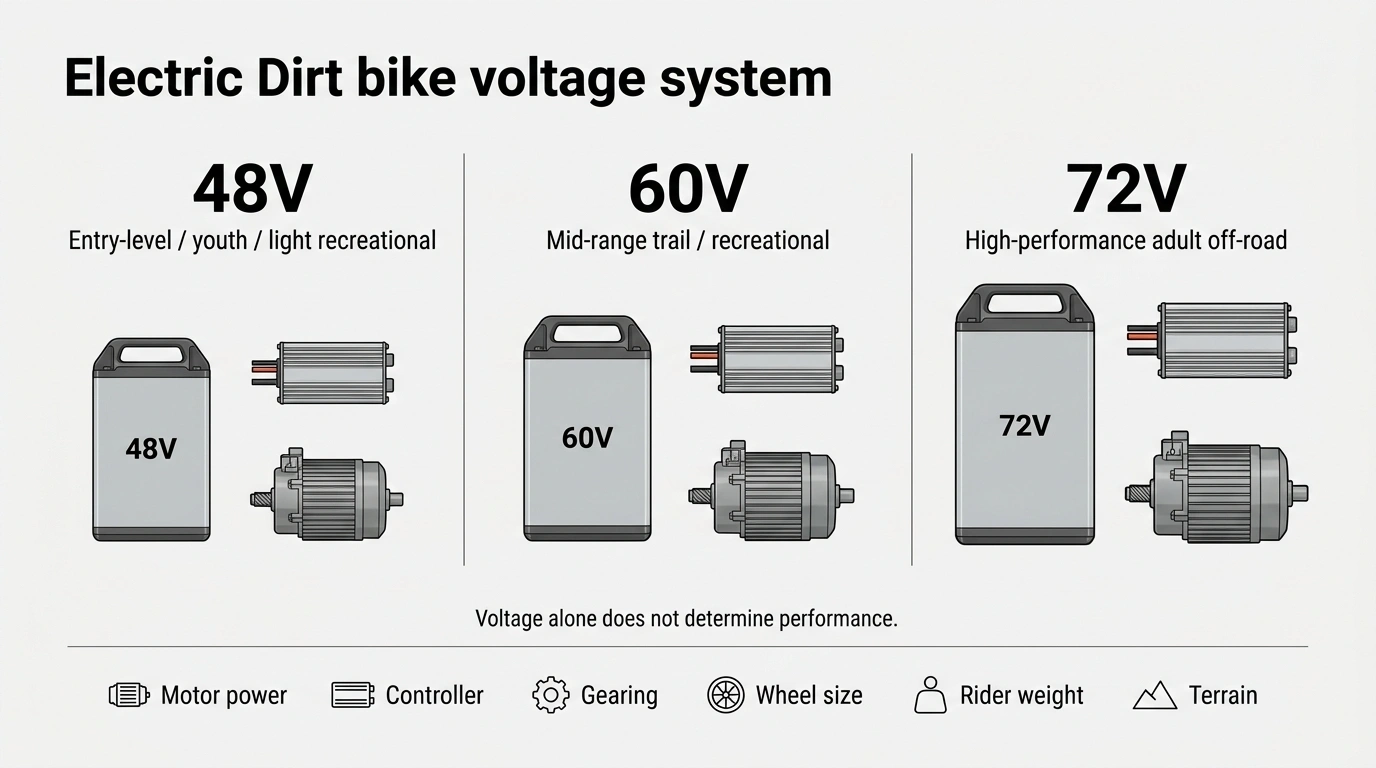
48V vs 60V vs 72V: What Each System Means
48V, 60V, and 72V are common voltage platforms used across electric dirt bikes and off-road motorcycles. Here is a practical overview:
| System | Common Applications | Typical Performance* |
|---|---|---|
| 48V | Entry-level, youth, and light recreational models | Lower-power, lower-speed configurations |
| 60V | Mid-range trail and recreational bikes | Moderate to high performance |
| 72V | High-performance adult off-road bikes | Higher-performance configurations |
Nominal voltage versus full charge: the 48V, 60V, and 72V labels in this guide are nominal platform names, which makes comparisons easier. The voltage shown by a fully charged lithium battery is higher and depends on cell chemistry and series-cell count. For example, a common 20S lithium-ion pack marketed as 72V reaches about 84V at full charge, which is why a “72V” bike may show roughly 84V on its display immediately after charging. A platform marketed as 60V may use different series counts, so verify the manufacturer’s actual full-charge voltage rather than assuming one universal number.
Performance varies widely within each voltage class. Voltage is one part of a complete drive system; it does not create a universal speed, torque, or rider category. Compare the manufacturer’s published top speed, continuous power, controller settings, gearing, wheel size, rider limits, and intended terrain model by model.
One model-specific example is BSE’s E60, listed at 60V, 3000W nominal / 6000W peak, and about 56 mph. That figure reflects its complete configuration — motor and controller tuning, gearing, wheel size, and vehicle setup — not a promise that every 60V bike will perform the same way. For a non-BSE reference point, Surron USA lists its Light Bee X with a 60V/40Ah battery and a stated 46.6 mph top speed. These individual manufacturer specifications illustrate why voltage labels alone do not predict finished-bike performance.
Voltage is not a quality score. A 72V bike is not automatically faster or more capable than a 48V bike. Compare the complete drivetrain, speed setting, fit, and intended terrain. For a child or first rider, start with the manufacturer’s age and size guidance, a suitable low-speed setting, braking performance, and parental controls.
Wattage Explained: Power for Speed, Torque & Hill Climbing
Wattage is an important indicator of a bike’s power capability, but it does not tell you how strong the bike will feel on its own. Actual acceleration and hill-climbing performance also depend on controller current, motor characteristics, gearing, vehicle weight, traction, and thermal limits.
Use stated wattage as a starting point, then compare the continuous figure with the complete drivetrain. A lower-wattage, lighter bike with suitable gearing can be a better match for a particular rider and trail than a heavier bike with a larger headline number.
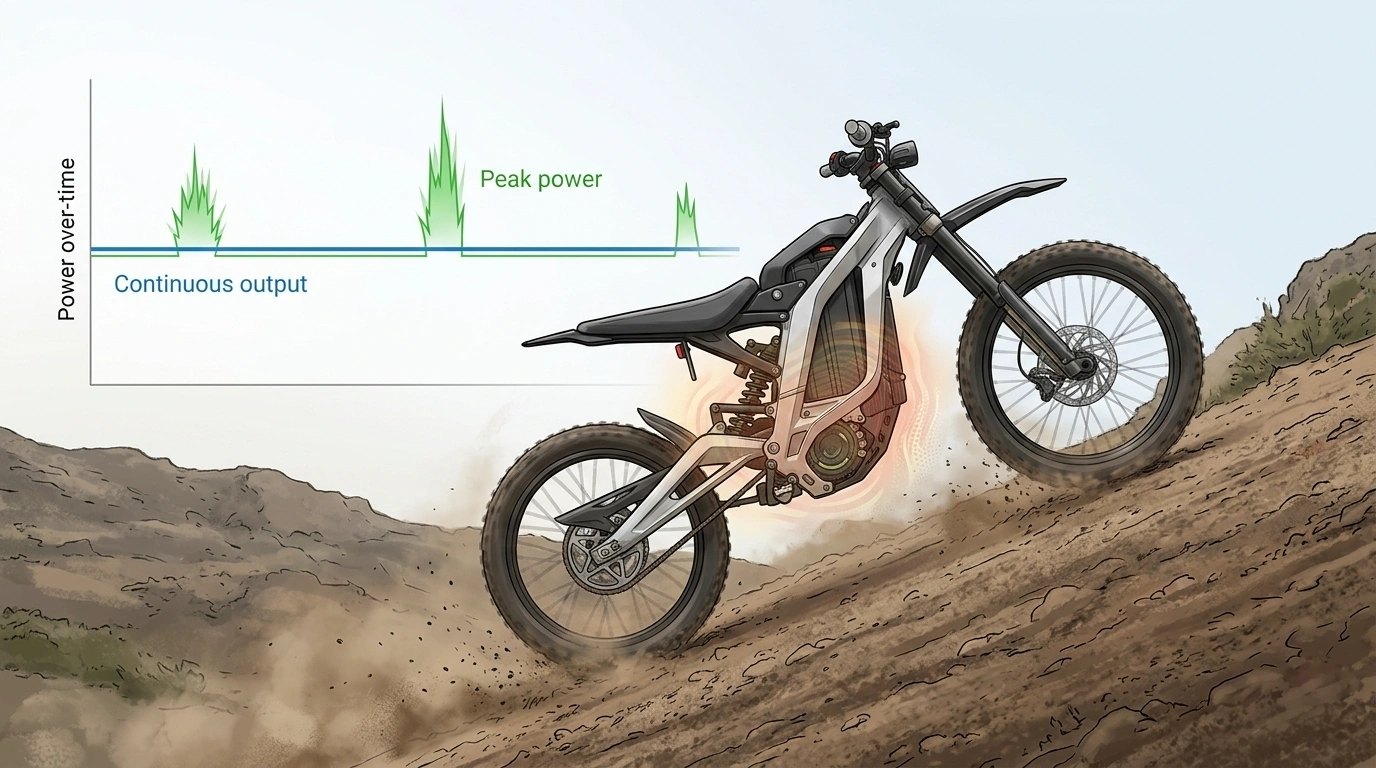
Peak vs. continuous wattage: some sellers quote “peak” wattage, which the motor can only hit briefly. A motor rated at 1200W continuous and 2000W peak can sustain about 1200W under its continuous rating while delivering higher power for short periods. Always compare continuous wattage first, then check peak — and confirm how the manufacturer defines each figure.
Thermal management matters. During repeated hill climbs, deep sand, or sustained high-speed riding, the motor and controller generate heat. A controller or battery-management system may reduce output to protect components when temperatures rise. That is why a bike’s sustained output, cooling design, and thermal protection can matter more on a long climb than an impressive short peak-power figure.
Note also that some markets regulate by wattage — a 750W or 1000W limit in certain street-legal categories means buying more power can move you into a different legal class. Check local rules; our street-legality guide explains how local laws classify powered bikes.
How Voltage and Wattage Work Together
Because watts = volts × amps, the two are linked. The practical consequence:
- At the same power level, a higher-voltage system draws less current. That can reduce resistive losses in the wiring and power electronics. Conductor size and overall efficiency, however, depend on the full drivetrain — peak current, motor and controller design, and thermal management.
- Higher voltage for a given power can let the motor spin faster — which is why many high-speed models use 60V or 72V systems, though gearing and controller limits also set top speed.
- Motor current is closely related to torque. A motor and controller that can deliver higher current can accelerate harder, regardless of the voltage label.
In practice, the specs worth comparing are continuous wattage, how the motor and controller are matched, and battery capacity — not the voltage label alone. Two bikes with similar nominal wattage can perform very differently depending on torque curve, controller capability, gearing, and thermal management. The motor produces power, but the controller governs how much current reaches it. Its current limits are the practical valve between the battery pack and the motor’s available torque.
| المواصفات | Mainly Affects | Do Not Use It Alone to Judge |
|---|---|---|
| Voltage | Motor speed potential | Finished-bike top speed |
| Current | Torque and acceleration potential | Total power or sustained output |
| Continuous power | Sustained performance | Short-burst acceleration |
| Peak power | Short bursts | Long-term output |
| Watt-hours (Wh) | Stored energy and range potential | Actual range |
| وحدة التحكم | How power is delivered | Motor capability alone |
| نسبة التروس | Wheel torque versus speed | Motor power alone |
For perspective on what to expect from a mid-size adult electric bike, our dirt bike speed guide covers real-world speeds by spec class.
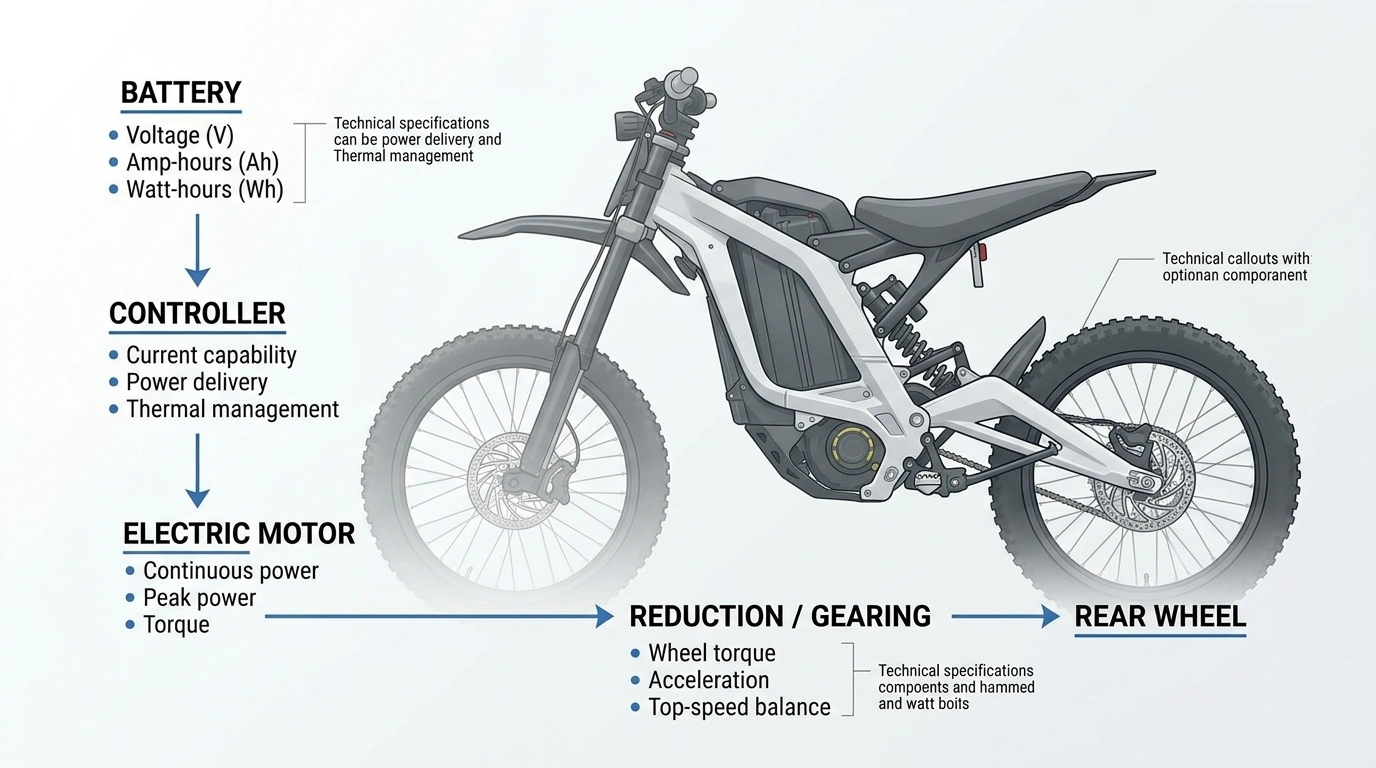
What Else to Compare: Controller, Gearing & Torque
Voltage and wattage are only the start. If a spec sheet gives enough detail, use the items below to judge how a bike will feel on a hill or out of a corner. If it does not, ask the seller rather than assuming that a headline wattage tells the whole story.
| Spec to Check | What It Changes | How to Read It |
|---|---|---|
| Controller phase current and battery/bus current | Phase current is the closer indicator of launch torque; battery/bus current helps set available input power and battery heat | Ask for continuous and peak values for both. If a spec sheet shows only one current number, ask whether it is phase current or battery/bus current, and request the continuous value. Phase current is the controller output to the motor; battery/bus current is what the pack and BMS must supply. Do not compare either peak-amp number alone. |
| Motor type and reduction | How motor rpm becomes wheel torque | A motor with a suitable reduction drive can trade rpm for wheel torque. Compare the motor/controller package and any published torque data, not the motor label in isolation. |
| Final gearing | Acceleration and climbing versus top speed | Lower gearing generally favors wheel torque and climbing; taller gearing generally favors speed. For example, 12T front / 60T rear is a 5.0:1 sprocket ratio and is more torque-focused than 14T front / 48T rear (about 3.4:1), which is relatively taller. Compare front/rear sprockets or final-drive ratio when available. |
| Wheel size | Effective gearing, traction, and handling | For the same drive setup, a larger wheel changes the effective gearing and can reduce wheel force. Compare wheel size alongside gearing and intended terrain. |
| Battery and BMS | Range and sustained power delivery | Compare Wh for stored energy, then ask about continuous discharge capability and BMS limits. A large Wh number alone does not guarantee sustained high-output riding. |
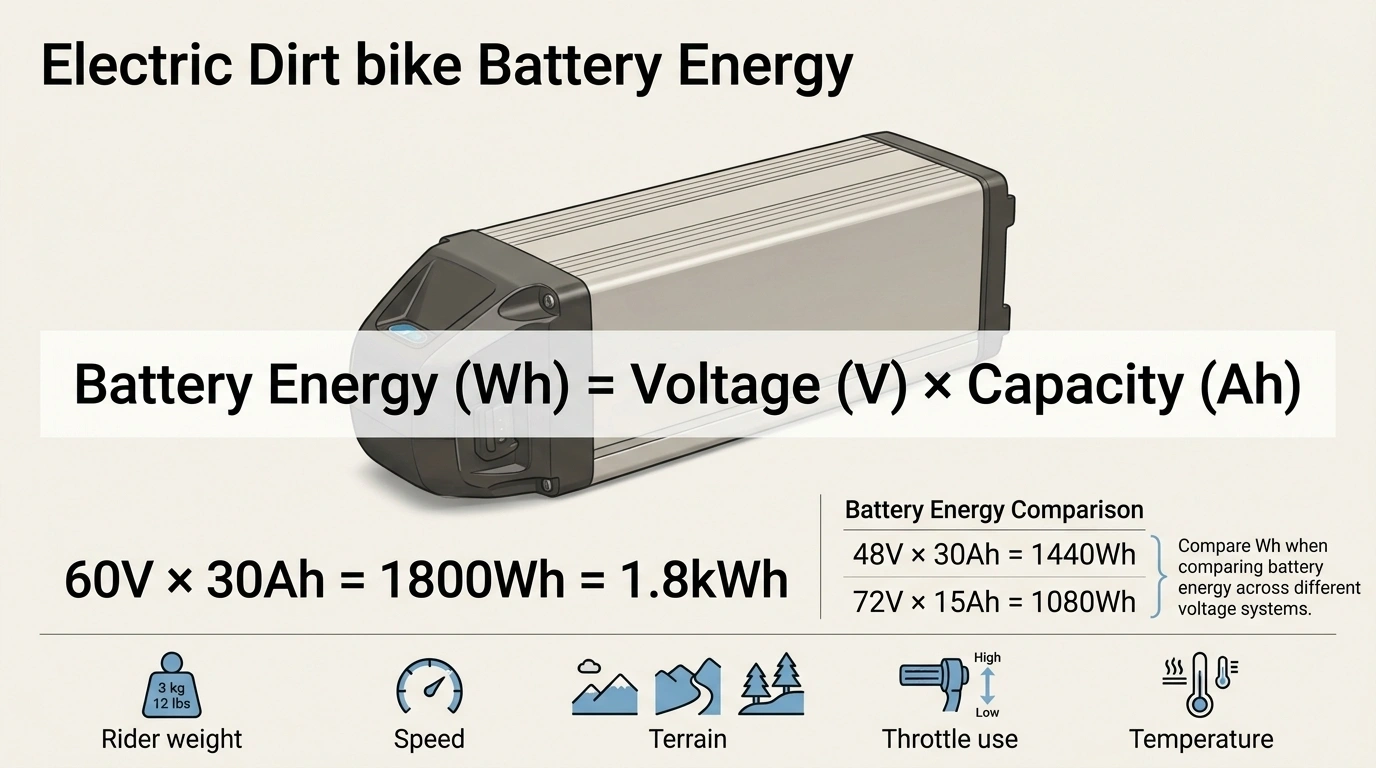
Battery Capacity (Ah & Wh) and Range
Battery capacity is one of the main factors affecting how far a bike can go, and it is one of the most commonly misunderstood specs. Speed, rider weight, terrain, throttle use, temperature, tire pressure, and drivetrain efficiency still affect real-world range.
| Battery Spec | What It Means | Example |
|---|---|---|
| Voltage (V) | System voltage — influences the speed ceiling | 60V |
| Amp-hours (Ah) | Capacity — how long it lasts (at that voltage) | 20Ah |
| Watt-hours (Wh) | The most useful battery-energy figure for range across different voltages (V × Ah) — think of it as the battery’s energy tank | 60V × 20Ah = 1200Wh |
Battery Energy Formula
Battery Energy (Wh) = Voltage (V) × Capacity (Ah)
Example: 60V × 30Ah = 1800Wh = 1.8kWh. This lets you compare stored energy across different voltage systems before estimating range.
Watt-hours (Wh) is what you should compare for range. A 48V/30Ah bike (1440Wh) will typically outlast a 72V/15Ah bike (1080Wh) even though the 72V bike is faster. There is no universal miles-per-Wh figure for electric dirt bikes — range depends heavily on rider weight, speed, terrain, throttle use, temperature, tire pressure, and drivetrain efficiency.
Two capacity tips: battery capacity gradually decreases with age, charge cycles, temperature exposure, and storage conditions; and cold weather cuts range noticeably. Store the battery at partial charge in moderate temperatures to make it last.
How to Choose the Right Spec for Your Riding
Here is a decision path that works for most buyers:
| Rider | What to Prioritize | What to Check Before Buying |
|---|---|---|
| Child / first bike | Manufacturer age and size recommendation, low speed, rider fit, braking, and parental controls | Actual speed setting, seat height, weight, protective equipment, and where the child may legally ride |
| Teen / lighter rider | Rider weight, actual speed, controller setting, and terrain | Continuous power, speed setting, braking, fit, and the complete drivetrain |
| Adult recreational | Continuous power, Wh, gearing, rider weight, and terrain | Controller capability, vehicle weight, hill requirements, range assumptions, and thermal protection |
| Adult performance | Continuous power, controller capability, torque, gearing, and battery discharge capability | Skill level, braking and suspension, thermal protection, legal restrictions, and suitable off-road riding areas |
Safety and legal reminder: high-power electric dirt bikes may not be legal to ride on public roads in many places. Before buying, confirm local rules for motor power, top speed, vehicle category, registration, lighting, insurance, and where off-road riding is permitted.
Three rules to avoid over-buying:
- Match the full setup to rider weight and terrain. Compare the bike’s continuous power, torque delivery, gearing, controller current, speed setting, rider weight, and intended use. Do not choose a voltage platform solely for a larger number.
- Match the package to terrain and rider. Flat suburban riding rarely needs a high-power build. Heavier riders and steep terrain generally require more available motor power and wheel torque — but voltage alone does not determine hill-climbing ability; torque, gearing, and controller current matter more.
- Compare continuous wattage and Wh, not peak wattage or headline voltage. Judge continuous power together with torque, controller capability, gearing, battery capacity, and vehicle weight when estimating real-world performance and range.
If you are buying a first electric bike for a child or weighing gas-vs-electric for yourself, our dirt bike size guide for kids nails the right size for a young rider.
الأسئلة الشائعة
What does 60V mean on an electric dirt bike?
60V is the battery system’s nominal voltage label. For a given motor design, higher voltage can increase speed potential, but the finished bike’s speed and feel also depend on motor design, controller settings, gearing, wheel size, rider load, and terrain. Check the complete model specification rather than treating 60V as a fixed performance class.
Is a higher voltage electric dirt bike faster?
It can be, but voltage alone does not set top speed. A higher-output bike at one voltage can overlap with a lower-output bike at another voltage. Compare the complete setup: continuous power, controller current, motor characteristics, reduction or gearing, wheel size, speed setting, rider load, and terrain.
What voltage electric dirt bike should an adult get?
A 60V system is often a practical middle ground for adult trail riding, but the right choice depends more on the complete drivetrain, rider weight, terrain, intended speed, vehicle weight, and controller settings than on voltage alone. Compare manufacturer specifications model by model before choosing a voltage platform.
What is the difference between 48V and 72V electric dirt bikes?
They offer different electrical headroom, but their finished performance can overlap. In either class, motor design, controller current, reduction, gearing, wheel size, speed settings, rider load, and terrain determine the finished bike’s speed and wheel torque. At the same electrical power, a higher-voltage system draws less current and can reduce resistive losses, but overall efficiency and capability depend on the complete drivetrain.
How many watts does an electric dirt bike need?
There is no universal wattage target. Start with the manufacturer’s intended rider, actual speed setting, vehicle weight, terrain, braking, and fit. Then compare continuous power, controller capability, gearing, battery discharge capability, and thermal protection. Always distinguish continuous power from a short peak-power number.
Conclusion: Buy the Spec That Matches Your Riding
Voltage, wattage, and battery capacity each control a different part of the experience — speed ceiling, power/acceleration, and range. None of them is “better” in isolation; the right combination depends on who is riding, where, and for how long. The smartest buyers compare continuous wattage و watt-hours, ignore inflated peak numbers, and match voltage to the rider’s weight and terrain.
خطواتك التالية:
- Identify the rider’s weight and the terrain — this sets your voltage and wattage target.
- Compare Wh (range) across the models you are considering, not just the price tag.
- Browse the BSE electric dirt bike lineup to compare 60V and 72V models side by side.
واصل التعلم
Shop BSE Motor Electric Dirt Bikes by Voltage
From 48V youth models to 72V adult performance machines, BSE Motor manufactures electric dirt bikes for riders and wholesalers worldwide.
View Electric Dirt Bikes →مراجع
- Electric Bike Report. “Electric Bike Motor: How Much Power Do You Need?” Electric Bike Report. Read the motor power guide
- Bosch eBike Systems. “Battery Knowledge: Volts, Ampere-Hours and Watt-Hours.” Bosch eBike Systems Help Center. Read Bosch battery knowledge
- Surron USA. “Light Bee X — 60V/40Ah battery and 46.6 mph stated top speed.” Surron USA. View Light Bee X specifications
- BSE Motor. “E60 Electric Dirt Bike — 60V, 3000W nominal / 6000W peak.” BSE Motor product page. View E60 specifications
 AR
AR  EN
EN  FR
FR  DE
DE  RU
RU  ES
ES  PT
PT  CN
CN