
Wichtigste Erkenntnisse
- Four mistakes account for most first-month problems with a new dirt bike, and buying a machine that is too tall sits at the top of the list.
- Our range spans 570 mm to 960 mm in seat height and 46 kg to 122 kg in kerb mass, so the spread between a youth machine and a full-size one is enormous.
- Displacement is a poor guide for a beginner, because we measured six 250cc machines between 10 kW and 26.5 kW, and an old 223cc design produced only 12 to 13 kW.
- Riding gear is not an optional extra, and the commission recommends a helmet and protective equipment at every ride.
- Setup gets skipped more than anything else, and the first question is simply whether the fork on your machine is adjustable at all.
Almost every problem a new rider meets in the first month traces back to one of four decisions, and none of them is about brand or colour. The machine is too tall, so the rider never feels secure at a standstill. There is no gear, so the first fall costs far more than it should. The engine is larger than the rider can use, so the throttle becomes something to fear rather than to learn. Finally, nobody set the machine up, so the bike arrives with settings that suit a different rider and nobody checks whether they can be changed. We measured seat height, kerb mass, fork travel and engine output across our own range, and the figures make each mistake easy to see before you spend money.
One note on how we talk about numbers. We list what our own engineers measured on our own machines, and we leave a figure out when we do not have one we trust. Several common claims in this category, such as a factory suspension setting calibrated to an average rider weight, appear in marketing copy and nowhere else.
Mistake 1: Buying Too Tall
Buying too tall is the most common and the most damaging mistake, because it removes the one skill a beginner needs most, which is the ability to stop safely. A rider who cannot reach the ground has to plan every stop in advance and hope the ground is level where they stop, and that anxiety changes how they ride long before it causes a crash. Seat height decides this, and the spread across our range is large enough that the choice matters more than any engine figure. We measured 570 mm at the smallest end and 960 mm at the largest, which is a difference of nearly forty centimetres.
The fix is not to buy a small machine forever, and it is to start on a machine the rider can control today. Kerb mass matters here as much as seat height does, because a rider who cannot pick the bike up after a fall will avoid the terrain where falls happen. Our range runs from 46 kg to 122 kg in kerb mass, and the lighter end is roughly a third of the heavier end. For example, a 60 kg rider on a 46 kg machine can lift it alone, while the same rider on a 122 kg machine usually cannot. Therefore, match both figures to the rider rather than to ambition, and accept that the second bike will come sooner than expected.
There is a practical measurement that beats every height chart, and it takes a minute at a dealership. Sit the rider on the machine in their riding boots, and check that the balls of both feet reach the ground comfortably with the machine held upright. Then ask them to reach the handlebar and the brake and gear levers without stretching or shifting their weight. In our experience, a rider who passes both checks learns twice as fast as a rider who passes only the first, because control of the bike starts with a stable platform under the rider. Consequently, treat the physical check as the decision and the published chart as background reading.
Height charts published elsewhere rarely survive that test, and the reason is that they convert an inseam measurement into a seat height without accounting for boots, seat shape or rider strength. We do not publish such a conversion ourselves, because we have no verified data to support one. Consequently, treat any table that promises a centimetre-for-centimetre match with suspicion, and use the physical check instead. It costs nothing and it is accurate.
Mistake 2: Skipping the Gear
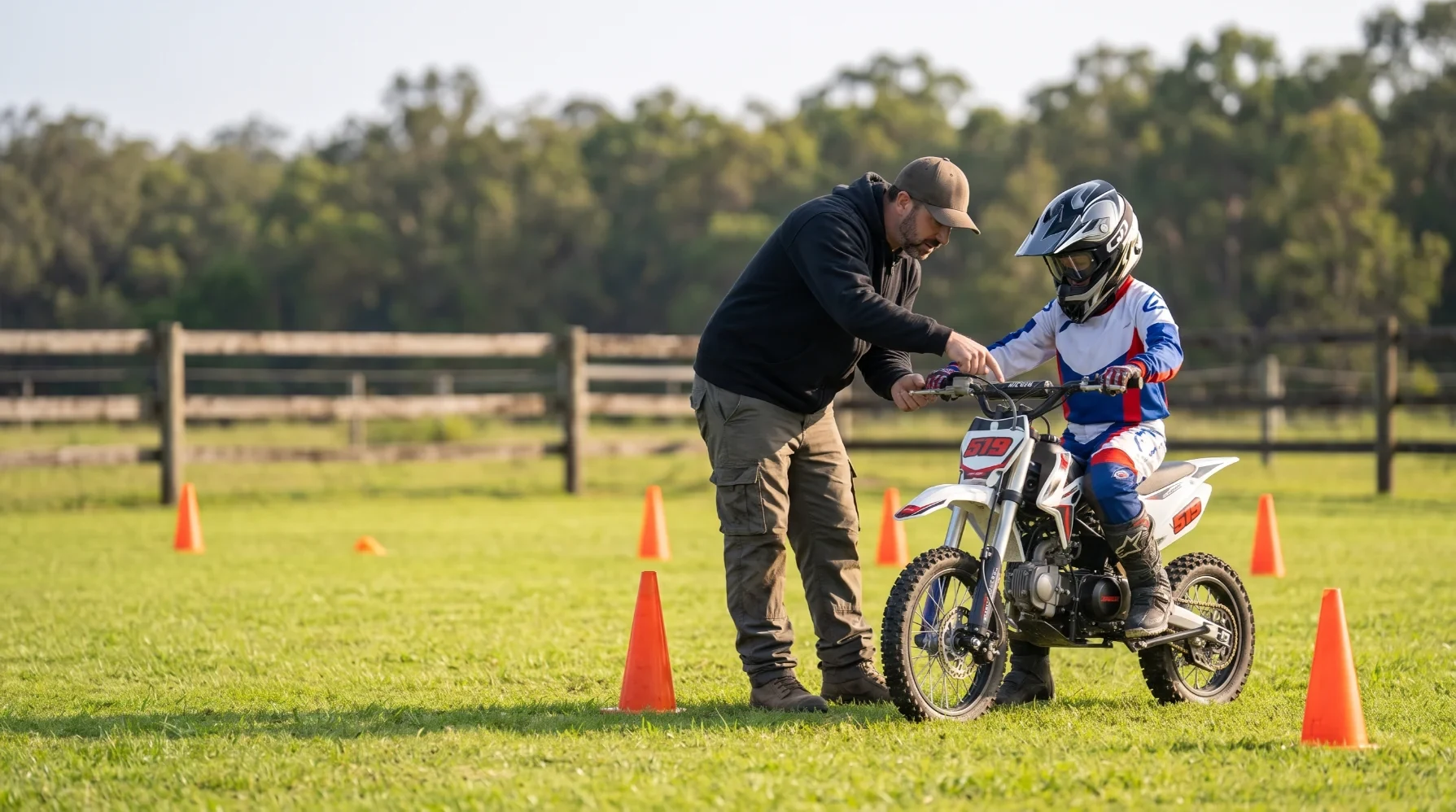
Skipping the gear is the second mistake, and it is the one that most often turns a minor fall into a serious injury. The Consumer Product Safety Commission recommends a helmet and protective equipment at all times, and it also advises riders to stay off paved public roads because off-road machines behave unpredictably on that surface. Those two pieces of advice cost very little to follow and they change the outcome of a normal beginner fall. A helmet, eye protection, gloves, boots and long sleeves are the minimum set rather than the aspirational one. Consequently, budget for gear in the same visit as the machine, because a fall in the first week is the likeliest incident of the whole first year.
Boots deserve a specific mention, because they are the item beginners most often replace with ordinary shoes. A dedicated riding boot protects the ankle and the lower leg from the bike itself, which is a real risk when a machine falls on a rider at low speed. Admittedly, boots feel awkward for the first few rides, and the awkwardness disappears within a week. Meanwhile, the protection lasts as long as the boots do, which is usually several seasons of beginner riding.
Gear also changes how a rider behaves, and that effect is worth more than the protection itself. A rider in proper equipment rides with more confidence and takes on the terrain that builds skill, while a rider in a t-shirt avoids everything and learns more slowly as a result. Therefore, buy the gear in the same purchase as the machine, and treat it as part of the machine rather than as an accessory. In our experience, the families who buy gear first have fewer early incidents, and the riders in them improve faster. Similarly, a rider who has always worn boots stops noticing them after the first week.
Mistake 3: Too Much Displacement
Too much displacement is the third mistake, and it survives because riders assume that engine size predicts how difficult a bike will be. We measured six 250cc machines in our own range and found output between 10 kW and 26.5 kW, which is a spread of more than two and a half times from machines of identical capacity. An older 223cc design that the industry has used for more than twenty years produces only 12 to 13 kW, while our 300cc model produces 19.8 kW at 8500 rpm. Therefore, capacity alone cannot tell you how much power a beginner will actually have to manage.
The right question is how the engine delivers what it has, and that is where a beginner should look first. A machine that produces its output smoothly across a wide range of engine speeds lets a new rider leave it in one gear and concentrate on balance and steering. A machine that produces everything near the top of the range forces constant gear work and clutch control, which competes for the same attention that should be going to the ground ahead. In other words, a well-behaved 250 can be easier to learn on than an aggressive 200. For example, our 300cc model makes 19.8 kW at 8500 rpm, which is a very different proposition from the 12 to 13 kW of the older 223cc design that many beginners still start on.
Three tests settle it without any technical knowledge, and every one of them happens at the dealership. Ride the machine slowly in a straight line and ask whether the throttle feels predictable at small openings. Turn a slow figure of eight and watch whether the machine stalls or lurches when the rider gets it slightly wrong. Then stop and start five times in a row, because that sequence shows how forgiving the machine is when the rider is tired. A beginner machine should pass all three, and one that fails any of them will cost the rider a season of practice. Meanwhile, ask the dealer to demonstrate the throttle with the engine running rather than describing it from a brochure.
Mistake 4: No Setup
No setup is the fourth mistake, and it hides because nothing visibly goes wrong. A machine delivered with suspension settings for a different rider will still start and still ride, and it will simply behave worse than it should in every corner and over every bump. The first question to ask about any machine is whether its fork is adjustable, because an adjustable fork can be set to suit the rider while a fixed one cannot. Fork travel across our range runs from 735 mm to 940 mm across seven models, and some of those units are not adjustable at all.
We are not going to publish a sag figure or a tyre pressure in psi for a specific rider, because both depend on the machine, the rider’s weight and the ground, and we have no verified table for either. What we will say is that the checks are straightforward and worth doing on the first day rather than the first month. Confirm whether the fork adjusts, set the tyre pressures to the figure in the machine’s own specification sheet, and check the chain tension against that same sheet. Then write down what you changed, so the next adjustment starts from a known place.
Setup also covers the controls, and this is the part beginners skip most often. Lever positions, handlebar position and the gear lever height are all adjustable on most machines, and a rider who has to reach for the brake learns to brake late. Spend ten minutes with the tools that came with the bike and move each control to where the rider’s hands and feet fall naturally. Admittedly, that sounds like a small detail, and it changes how quickly a beginner gains confidence. In addition, a rider who helped to set the machine up will notice when something has moved.
Finally, recheck everything after the first few rides, because new machines settle. Fasteners, chain, spokes, tyre pressures and lever positions all move slightly as the machine breaks in, and a rider who checks them once will usually find something. Therefore, treat the first month as a settling period rather than as a finished setup.
| Fehler | The test that catches it | The fix |
|---|---|---|
| Buying too tall | Balls of both feet on the ground in riding boots | Choose by seat height and kerb mass, not by looks |
| Skipping the gear | Is the rider wearing boots and a fitted helmet? | Buy helmet, eye protection, gloves, boots and sleeves with the bike |
| Too much displacement | Throttle response at small openings, and slow figure eights | Choose by power delivery, and check the output figure for the model |
| No setup | Is the fork adjustable, and are the levers where the hands fall? | Set pressures and chain tension from your own specification sheet |
Häufig gestellte Fragen
What size dirt bike should a beginner buy?
Choose by seat height and kerb mass rather than by engine size, because those two figures decide whether the rider can control the machine at a standstill. Our range spans 570 mm to 960 mm in seat height and 46 kg to 122 kg in kerb mass. Then check that the rider can reach the controls with both feet nearly flat on the ground (BSE Motor, 2026).
Is 250cc too much for a beginner?
It depends entirely on the machine, because we measured six 250cc models producing between 10 kW and 26.5 kW. A smooth 250 with broad power delivery is manageable for an adult beginner, while an aggressive one at the top of that range is not. Test the throttle response at small openings rather than trusting the capacity on the sticker.
What gear does a beginner need?
A helmet, eye protection, gloves, riding boots and long sleeves are the minimum. The Consumer Product Safety Commission recommends a helmet and protective equipment at all times, and riding boots protect the ankle and lower leg from the machine itself. Buy the gear with the bike rather than after it, and replace anything that no longer fits (CPSC, 2026).
Do I need to set up a new dirt bike?
Yes, and the first question is whether the fork is adjustable at all, because some machines are not. Set tyre pressures and chain tension to the figures in your own model’s specification sheet, then move the levers and bars to suit the rider. Recheck everything after the first few rides, since new machines settle as they break in.
Can I learn on a full-size dirt bike?
Some adults can, particularly taller and stronger riders, and most cannot start comfortably on the largest machines. The deciding factor is whether the rider can place both feet near the ground and pick the bike up after a fall. A lighter machine with a lower seat teaches faster than a full-size one, and it usually costs less to run as well.
Abschluss
Four mistakes explain most first-month problems, and each one has a simple test. Buy a machine the rider can hold at a standstill, because control starts there. Buy the gear with the bike, because it changes both the outcome of a fall and the rider’s willingness to learn. Choose by power delivery rather than capacity, since identical capacities produce very different outputs. Then set the machine up, starting with the question of whether the fork adjusts at all.
Ihre nächsten Schritte:
- Als Erstes sollten Sie die Sitzhöhe und das Leergewicht in Bezug auf den Fahrer überprüfen.
- Buy helmet, eye protection, gloves, boots and long sleeves in the same purchase.
- Test throttle response at small openings, not the capacity figure.
- Confirm the fork is adjustable, then set pressures and chain tension from your own specification sheet.
Weiterlernen
- Best beginner dirt bike for adultsModels and what to look for first.
- Motocross vs trail bike: what each is built forWhich category suits your ground.
- How range and torque workReading an electric specification properly.
- Motor wattage and voltage explainedWhat the numbers on the bike mean.
- Stöbern Sie in unserem Angebot an Dirtbikes.Beginner and full-size models.
Technische Daten der in diesem Leitfaden beschriebenen Modelle
Die folgenden Angaben stammen aus unserer eigenen Produktdokumentation (BSE Motor, 2026).
BSE PH02E — 125cc automatic
- Seat height 670 mm
- Kerb mass 62 kg
- Wheelbase 1,160 mm
- 6.5 kW at 7,000 rpm, no clutch lever
BSE PH02S — 50cc kids starter
- Seat height 590 mm
- Kerb mass 59 kg
- Wheelbase 1,050 mm
- 1.8 kW at 7,000 rpm, semi-automatic
Find a first bike that fits
Seat heights from 570 mm, kerb masses from 46 kg, and adjustable forks on the models that need them.
Dirtbikes ansehen →Referenzen
- US-Kommission für Produktsicherheit. Sicherheit von GeländefahrzeugenAbgerufen im September 2026.
- US-Kommission für Produktsicherheit. ATV-SicherheitsinformationszentrumAbgerufen im September 2026 (CPSC, 2026).
Seat height, kerb mass, fork travel and engine output figures in this article were measured by our own engineering team on our own machines, so they are not independent laboratory results (BSE Motor, 2026). This article was written by Mojo and reviewed by our engineering team. You can read more about us on the site, or contact our team with questions about a specific model.
 DE
 EN
 FR
 AR
 RU
 ES
 PT
 CN