
Key Takeaways
- Smooth throttle control prevents 80% of hill climb failures—not engine power.
- A gear higher than what beginners expect is the best gear for climbing steep hills.
- Standing on pegs with forward weight bias keeps the front wheel planted and steering responsive.
- Different types of terrain demand specific techniques because there exists no universal solution that works for every situation.
- Most hill climbs fail due to panic throttle inputs, not a lack of engine power.
This guide covers safe hill climbing techniques for single track, sand, rock, and mixed terrain. Whether you’re a beginner struggling with your first steep climb or an intermediate rider looking to tackle technical trails, you’ll find terrain-specific strategies and common mistake fixes below.
What Is Dirt Bike Hill Climbing and Why Is It Difficult?
Dirt bike hill climbing means riding a dirt bike on a steep hill using momentum, traction management, and properly positioning the body instead of using speed and engine power. Upon riding upwards, the gravity works against the forward motion, thereby reducing the traction at the rear wheels, increasing the chance of tire spinning.
Hill climbing is difficult because gravity reduces rear-wheel traction while amplifying every throttle and balance mistake. Unlike flat riding, small errors—wrong gear, jerky throttle, poor weight distribution—quickly compound into stalls or crashes.
How To Go Up A Steep Hill On A Dirt Bike? Essential Techniques And Hill Climbing Tips
Climbing steep hills safely requires five core skills: progressive practice, smart line selection, correct gear choice, balanced body position, and smooth throttle-clutch coordination. Master these fundamentals before attempting technical terrain.
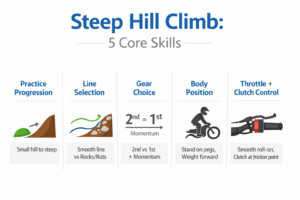
How to Practice Hill Climbing Without Crashing or Burning Out?
To practice hill climbing, begin with a small hill and work up gradually. Electric dirt bikes can help beginners practice with smoother power delivery and less stall risk.
The practice of jumping directly into large hills leads to constant failures, exhaustion, and loss of self-esteem. Riders mostly achieve quick improvement when they practice on moderate slopes, which allows them to make mistakes and learn from their experiences.
The process of learning how to handle low-risk hill climbs enables riders to develop their ability to remain calm during challenging situations. The primary cause of panic during climbing occurs when people use extra throttle while simultaneously dumping the clutch.
Line Selection and Trail Reading: Picking the Right Way Up
Walking the route before riding up a steep hill provides vital information that determines success or failure. While walking, look for:
- Rock clusters that can deflect the front wheel
- Loose dirt or sand that will sap momentum
- Soft patches that cause sudden wheel spin
- Ruts that can trap the bike or pull it off line
The shortest route to travel between two points typically does not provide the best path, so you need to choose the smoothest path and not the shortest one. The existing tyre tracks on single-track dirt bike trails show what areas have stable traction, but they should be avoided because deep tracks restrict steering abilities.
Which Gear Is Best For Uphill On A Dirt Bike? Momentum And Gear Strategy
The answer to which gear works best for dirt bike uphill riding depends on the specific terrain, plus engine power characteristics. The following gear recommendations suit most trail dirt bike applications:
- Second gear works well for moderate hills with decent traction.
- First gear is better for steep, technical, or rocky climbs where precision matters.
- In loose sand or mud, a higher gear can actually help by softening torque delivery.
Steep hills become easier to climb when you use momentum to your advantage, but high-speed movement becomes unsafe. Climbing requires you to bring enough forward momentum while going upwards, while you must remain in your control range for traction loss situations.
Gear selection is the key factor determining the results. Shifting mid-climb carries dangerous consequences and should be avoided except in emergencies. Shifting during this time requires the rider to take risks because it causes temporary power loss, which might result in a bike stall or traction loss.
Body Positioning: Staying Balanced on Steep Slopes
Correct body position keeps both wheels working instead of fighting each other. The pit bike or dirt bike rider can benefit from standing on the pegs because it creates space for the bike to move below them while giving them the ability to adjust to traction changes. To position your body, you need to:
- Lean forward enough to keep the front wheel planted, especially when climbing steep hills.
- When the front wheel lifts unexpectedly, it renders steering impossible and increases the risk of a crash.
- When you lean too far forward, your weight shift causes the rear tyre to lose contact with the ground, resulting in wheel spin.
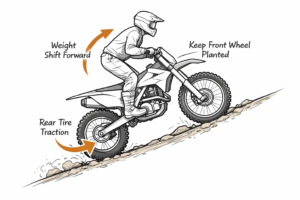
The key is constant adjustment. The rider needs to continuously adjust their weight distribution between forward and backward movements as they navigate increasingly steep hill climbs, where traction begins to decline.
The body can absorb shock from bumps by maintaining a relaxed arm posture and a bent-knee position, which help maintain equilibrium.
Throttle and Clutch Control: The Difference Between Grip and Spin
The most vital skill in hill climbing is smooth throttle control. Riders find that sudden throttle inputs on loose surfaces, such as dirt, roots, and rocks, cause their bikes to lose grip more quickly than expected.
Gradually rolling the throttle maintains rear tyre traction. The process of fading traction requires the rider to use clutch control at the friction point to maintain engine power while limiting torque.
Reading Feedback From the Bike and Terrain
The bike continuously provides status updates, which require your attention.
- The engine bogging problem occurs because the bike requires either an increase in RPM or a gear change.
- Wheel spin occurs when the system experiences a sudden RPM surge without any forward movement.
- You need to monitor three indicators: vibration, engine noise, and rear tyre performance.
Early-phase adjustments help prevent major issues from arising.
What Are Some Hill Climbing Techniques by Terrain Type?
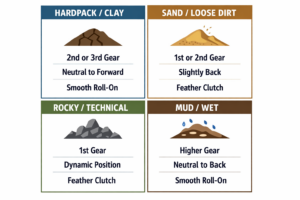
No single technique works for all terrain—hard-packed clay, loose sand, rocks, mud, and mixed surfaces each demand different throttle, body position, and line choices. The sections below break down specific strategies for six common terrain types.
Hard-Packed Dirt and Clay Hills
The surface of hard-packed dirt and clay hills provides riders with predictable traction, but it can become dangerous when polished by tyre wear or dust accumulation. Riders should maintain a neutral-to-slightly-forward posture, with a relaxed grip and elbows up, to improve balance.
Riders should maintain smooth throttle roll-on, which sustains traction while only using the clutch for speed adjustments. Also, riders should avoid shiny hardpack areas with hidden braking bumps and use existing tracks with consistent grip for a successful climb.
Sandy Hills and Loose Dirt
Sandy hills and loose dirt terrain have poor traction and a shifting surface. Momentum is lost quickly because of the high resistance of loose dirt and sandy hills. It is important to note that commitment is the key to a successful climb, whereas hesitation only leads to failure.
Riders must build balanced momentum before climbing and maintain a steady throttle position. Bending the body slightly backward helps maintain power delivery. However, sitting at the extreme back compromises steering control.
Furthermore, on such terrain, riders need to use the clutch to maintain engine power while avoiding tyre spin.
Rocky and Technical Hills
Such hills feature embedded rocks, ledges, and uneven steps, increasing the risk of deflection and imbalance. The technical hills demand precision more than speed. While climbing such hills, always choose the clean and least aggressive line. By avoiding loose rock piles and square edges, riders can climb safely.
To increase mobility, riders should stand with their knees bent to allow the bike to move freely. Also, use controlled throttle and clutch feathering to lift the front wheel over obstacles while maintaining balance.
Mud and Wet Terrain Hills
Mud and wet terrain hills provide minimal grip, making it easy for tires to lose contact and spin. Small changes in throttle can cause the bike to go from stable to uncontrolled wheel spin.
When riding such hills, riders should avoid shiny, slick ruts, as previous riders have used these paths, and they may be slippery. It is advisable to ride slightly off the center of the ruts, as this increases traction and reduces the risk of getting stuck.
The gear used when climbing technical hills should be higher to reduce torque delivery and reduce wheel spin. Also, smooth acceleration lets the tires maintain traction without losing grip. Whereas the sudden throttle changes can cause loss of control.
Riders need to maintain a balanced body position, as balanced movement helps them maintain stability during slips.
Grass, Roots, and Vegetation-Covered Hills
When wet due to rain or moisture, the grass-covered hills can become slippery, and the hidden obstacles under vegetation can act as wet logs. While riding such hills, always aim for worn tracks with exposed dirt to avoid slips, and cross roots at angles when possible. Similarly, avoid sudden throttle or steering movements while staying loose and centred.
Mixed-Terrain Hills
Mixed terrain hills, as the name indicates, include dirt, rock, sand, and vegetation. To climb these hills, you need to adjust the throttle and body position continuously. Riders ascending mixed-terrain hills should be mentally flexible and begin descending in an emergency.
What Are the Common Mistakes Riders Make on Steep Hills?
The common mistakes, their reasons, and how to fix them are provided in the table below:
| Mistake | Why It Happens | How to Fix |
|---|---|---|
| Intense throttle | Fear of stalling | Practice smooth throttle control |
| Poor body position | Lack of experience | Practice body balance techniques |
| Wrong gear choice | Reactive riding | Plan gear before the climb |
| Not understanding terrain | Tunnel vision | Look several meters ahead/ Walk the route before climbing the bike |
| Front wheel lifting | Weight too far back | Shift forward and feather clutch |
FAQs
What’s the biggest key to climbing a steep hill on a dirt bike?
Controlled momentum and correct gear selection. Enter the climb with enough speed to maintain forward progress, but not so fast that you lose control when traction drops.
Can any dirt bike climb steep hills?
Yes, most of the modern dirt bikes can climb steep hills. The bike’s tyre, gear ratios, and rider skills are more important than engine horsepower.
Should I stand or sit when climbing?
It’s better to stand, as standing offers better balance and control on steep hills.
What should I do if the rear wheel spins?
If the rear wheel spins, shift your weight forward and operate the engine at lower power while using the clutch for controlled delivery.
Does tyre pressure affect hill climbing?
Yes—lowering tire pressure by 2-4 PSI from normal trail settings increases traction by allowing the tire to conform to terrain. However, never go below the manufacturer’s minimum (typically 12-14 PSI for most dirt bikes) to avoid rim damage or pinch flats.
What should I do if my bike starts tipping backwards on a hill?
Immediately lean forward, pull in the clutch, and apply the rear brake. If the bike continues tipping, step off to one side—never let the bike fall backwards onto you. Once stopped, use the clutch and throttle together to restart your climb.
How do you stop safely on a steep hill?
Pull in the clutch and apply both brakes smoothly. Keep your weight forward to prevent rolling backwards. If you need to restart, hold the rear brake, release the clutch to the friction point, then release the brake as you apply throttle.
Conclusion: Skill Beats Power on Steep Hills
Climbing steep hills is not about power; in fact, it’s about skills, patience, and strategy. To climb steep hills, riders need to adjust their skills as per the terrain. Balancing momentum, body positioning, and throttle control is vital to preventing bike slipping.
Beyond practice and skills, choosing the right hill-climb dirt bike also makes a difference. Always choose a reliable dirt bike manufacturer for long-term benefits. BSE Motors is a Chinese manufacturer of bikes designed to help riders ride up the hills safely.
 EN
EN  FR
FR  DE
DE  AR
AR  RU
RU  ES
ES  PT
PT  CN
CN