
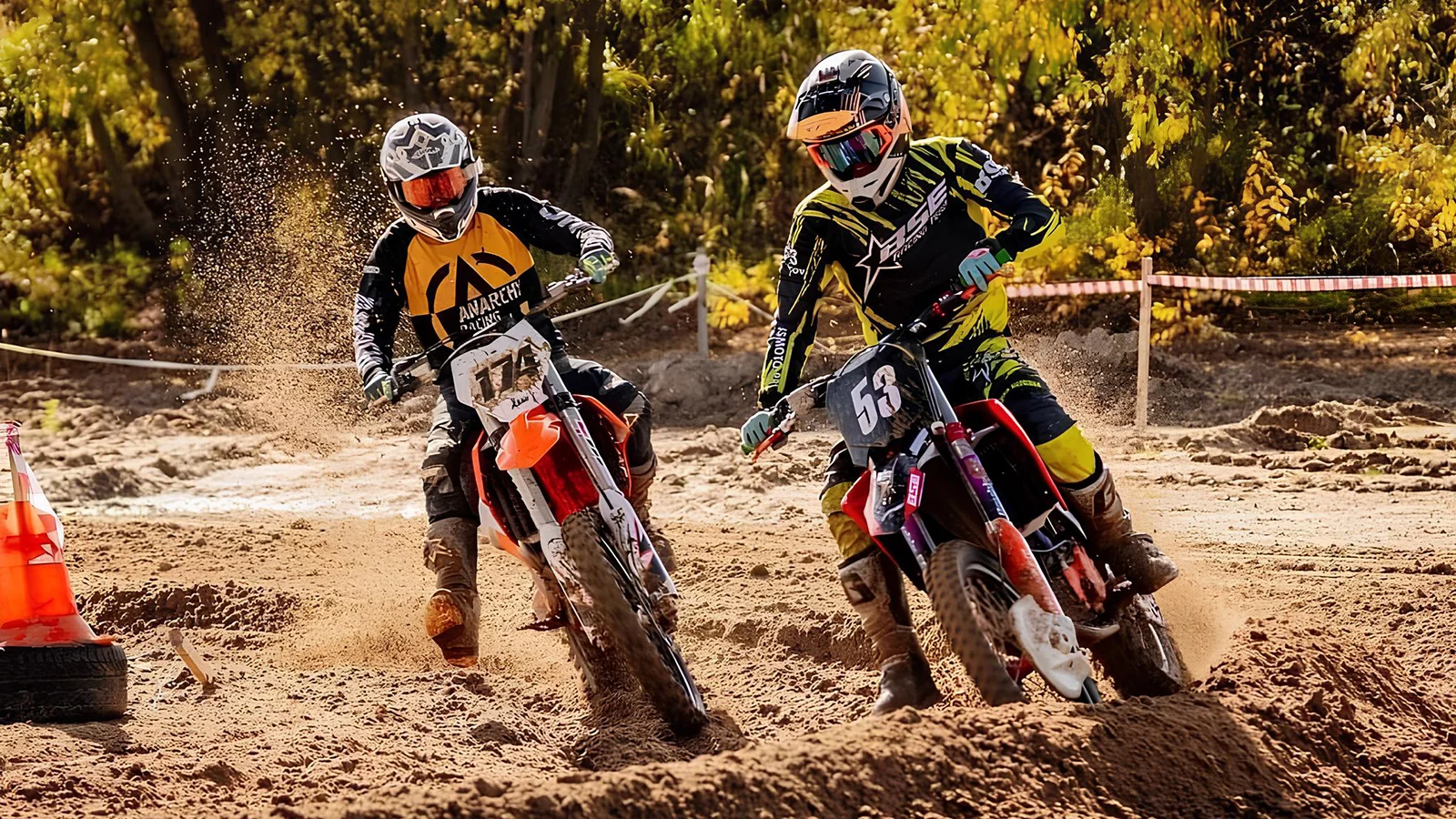
Key Takeaways
- Motocross and trail riding are not two sizes of the same thing, because each scene places a different physical demand on the machine.
- Trail riding needs sustained low and mid-range torque, suspension that absorbs rather than resists, and rear grip, which is why trail bikes run a 140 rear tyre.
- Motocross needs peak power in a narrow window, hard long-travel suspension for jumps, and a light machine with no lights or handguards.
- One displacement can carry two completely different tunes, and gearing does much of the work, so compare ratios such as 520-13/49 against 520-13/45 rather than comparing capacity alone.
- Choose by where you spend 90 percent of your time, not by which machine looks more capable on a specification sheet.
Almost every motocross versus trail bike comparison you can find arranges two lists side by side, one column of motocross traits and one column of trail traits, and then leaves the reader to guess which column matches their weekend. That format tells you what the machines are like, and it never tells you why they have to be different. The two categories exist because two scenes place different physical demands on a bike, and every mechanical difference between them traces back to one of those demands. Once you see the demands, the specifications stop looking like arbitrary preferences and start looking like answers. We build both kinds of machine, and our three race teams have put them through a full season across three surface types, so we can show you where the mechanical logic actually lands.
This article covers trail riding against motocross only. The separate question of how motocross, enduro, trials and cross-country racing differ from each other is a question about sport categories, and that belongs in a different discussion. Here the topic is the machine and the job it was built to do.
What Trail Riding Actually Demands
Trail riding asks for three things at once, and they are sustained torque through the low and middle of the rev range, suspension that absorbs impacts instead of resisting them, and rear grip on loose ground. Those three demands explain almost every visible difference between a trail bike and a motocross bike. Consider a steep climb that is also tight, where the rider has to keep the bike moving while steering around roots and rocks. There is no room to build revs before the climb, and there is no straight section where speed can be carried into it. The machine has to pull from low revs and keep pulling as the ground changes underneath it, which is why riders describe a good trail engine as having torque rather than power.
Long rough ground punishes a stiff setup, and this is the second demand in practice. Over a two-hour ride the rider meets hundreds of small impacts, and a suspension that transmits all of them wears the rider out long before the bike runs out of anything. Therefore trail suspension is tuned to be softer and more progressive than a racing setup, and the goal is not comfort for its own sake but the ability to keep riding well at the end of the day. Similarly, grip matters more on trail than peak speed does, because a loss of traction on an off-camber root costs far more time than a small deficit in top-end power ever will. Our trail bikes run a 140 rear tyre specification for exactly this reason, since a wider contact patch keeps drive going to the ground on loose surfaces.
Practical equipment follows the same logic, and it is worth noticing how much of a trail bike exists purely because of the scene. Handguards protect levers from branches and from the bike itself when it falls in tight terrain. A headlight extends the ride into the evening and matters any time a route runs longer than planned. Wider tyres and a wider spread of ratios make the machine easier to ride slowly without stalling, which is the part of trail riding that beginners underestimate. In our experience, riders who move from a motocross machine to a trail machine notice the low-speed behaviour first and the suspension second, because both changes show up within the first few hundred metres of a tight section.
What Motocross Actually Demands
Motocross asks for peak power inside a narrow window, hard suspension with long travel, and the lowest possible weight. A moto is short, and the rider spends nearly all of it at high revs, so the engine only has to be strong where the rider actually uses it. Outside that window the machine can be weak without costing anything, because nobody rides a motocross track at a walking pace. Engineers design for that specific window, and the result feels abrupt to a rider who is used to a broad torque curve. Our race-oriented engines use a PWK34 carburettor, which is the kind of specification that only makes sense once you accept the narrow powerband as the design goal rather than as a fault.
Jumps set the suspension requirement, and they explain the difference in feel more clearly than any description of stiffness can. A landing transfers an enormous load into the chassis in a fraction of a second, and the suspension has to absorb that load without collapsing or bouncing the rider off line. Consequently motocross suspension runs long travel and firm damping, and the settings trade comfort for control at speed. On a rough trail that same setup becomes exhausting, because every small impact arrives at the rider instead of being absorbed, which is why riders who only trail ride rarely enjoy a borrowed race bike on a long day out.
Weight follows from the same demands, and motocross machines carry no headlight, no handguards and no lighting harness because none of that equipment helps on a closed course. Removing it saves mass that has to be accelerated out of every corner and lifted over every jump. Therefore a race bike will always feel sharper than a trail bike of similar capacity, and it will always be less pleasant when the ride gets long. That trade is deliberate, and neither machine is a compromise on the other, because they were never aiming at the same target in the first place.
Engine Tuning: Same Displacement, Different Job
Two machines of identical displacement can feel nothing alike, because displacement sets the size of the engine and tuning decides the character of it. Cam timing, ignition advance, intake and exhaust design, and carburettor or injection specification all shift the shape of the power curve without changing capacity by a single cubic centimetre. In practice, a designer can move output from the bottom of the rev range to the top, and every position in between is a legitimate choice. For example, a trail tune spreads torque broadly so the rider can leave it in one gear through a technical section, while a race tune concentrates output near the top so the rider can use the gearbox and the clutch to keep the engine in its strongest band.
Gearing does at least as much work as the tune, and it is the part riders forget to check. A 520-13/49 combination gives a shorter overall ratio and stronger acceleration, which suits a closed course where the machine never needs to reach a high speed. A 520-13/45 combination spreads the same engine over a longer ratio and suits trail and general use, because the rider can hold a gear through a section instead of shifting constantly. Our smaller platforms use 420-15/41 and 420-14/39 for the same purpose at lower capacity, and the choice between them follows the intended scene rather than the engine size. Therefore, when you compare two machines, compare the final ratios as well as the capacity.
Our own approach is to prepare different tunes and different gearing for different uses rather than to build one universal setting, and the reason comes from what we measured across a full season of racing. Our three race teams competed in 97 races in a single year, on track surfaces, trail surfaces and ordinary roads, and we found that the same chassis needed different setups on each of the three. That experience is why we treat the setup sheet as part of the product rather than as an afterthought, and why we publish the ratios openly instead of hiding them behind a single model name.
Suspension and Tyres: The Differences You Can See
Suspension travel and tyre specification are the two differences a rider can measure with a tape in a garage, and they track the demands of each scene very closely. We measured front fork travel across seven models in our current range and found a spread from 735 mm to 940 mm, with the longer-travel setups aimed at rough going and the shorter ones at tighter and slower use. Travel alone does not tell you how a fork will feel, because damping and spring rate control that, and adjustability varies from model to model. Still, the travel figure gives you the first honest clue about which scene the machine was designed around.
Tyre specification works the same way, and wider is not automatically better. A wider rear tyre puts more rubber on the ground and improves drive on loose trail surfaces, which is why a 140 specification suits trail riding. A narrower tyre cuts into soft ground and clears mud more effectively, which suits a groomed race surface where a wide tyre would simply pack up and lose grip. Therefore the correct question is not which tyre is bigger but which tread and width pattern matches the surface you actually ride on. Riders who fit a trail tyre to a race bike often report that nothing improved, because the mismatch was in the surface rather than in the rubber.
| Specification | Trail machine | Motocross machine |
|---|---|---|
| Power delivery | Low and mid-range torque | Peak output, high in the range |
| Suspension | Absorbs long rough ground | Hard damping, long travel for jumps |
| Rear tyre | 140 specification for grip | Narrower tread for a groomed surface |
| Gearing example | 520-13/45, general use | 520-13/49, acceleration |
| Equipment | Handguards, headlight, wider tyres | No lights, no handguards |
Adjustability is the last piece, and it matters more as you improve. A trail machine that offers clicker adjustment lets a heavier rider add spring preload and damping without changing parts, and most riders never touch those adjusters until someone shows them what each one does. Consequently, the same bike can suit a range of riders, which is why seat height and kerb mass vary so widely across our line-up. That range runs from 570 mm to 960 mm in seat height and from 46 kg to 122 kg in kerb mass, and the spread exists because a young rider on a small machine and an adult on a full-size one are not asking for the same bike at all. Match the machine to the rider before you match it to the scene.
Which One Should You Buy?
Buy for where you spend 90 percent of your time, and treat the remaining 10 percent as something you are willing to compromise. A rider who rides a closed course almost every weekend wants the race machine, because the traits that make it tiring on a trail are exactly the traits that make it fast on a track. A rider who explores trails, fire roads and wooded singletrack wants the trail machine, because broad torque and softer suspension make every one of those rides easier. In addition, a rider who genuinely splits time between both should start with a trail machine, since a trail bike handles a casual track day far more comfortably than a race bike handles a four-hour trail ride.
Three questions settle most of these decisions, and none of them require technical knowledge. Where does the bike spend most of its hours? How long is a typical ride? Does the ground include jumps and a groomed surface, or roots and loose rock? Answer those honestly and the category picks itself, because the demands of the scene are not negotiable and the machine either meets them or it does not. Only after you have chosen a category does it make sense to compare models within it, and at that point you should look at seat height, kerb mass and gearing first.
Frequently Asked Questions
Can you trail ride a motocross bike?
Yes, and plenty of riders do, but the machine works against you in three ways. Hard damping transmits every root and rock to the rider over a long day, the narrow powerband forces constant clutch and gear work at low speed, and the gearing runs short for acceleration rather than for steady progress. A motocross bike on a trail is at its best on open fast ground and at its worst in tight technical sections (BSE Motor, 2026).
What is low-end torque?
Low-end torque is the turning force an engine produces at low engine speed, and it decides whether a bike can pull away from a near stop on a steep climb. An engine with strong low-end torque lets the rider hold a gear through a technical section instead of slipping the clutch to keep revs up. Therefore torque matters most where the ground is steep and tight, which is exactly where a trail rider spends the difficult part of a ride.
Why do trail bikes have wider tyres?
A wider tyre puts a larger contact patch on the ground, and a larger patch improves drive on loose surfaces such as gravel, mud and leaf litter. We run a 140 rear specification on our trail machines for that reason. A narrower tyre works better on a groomed race surface, where it cuts in and clears mud instead of floating on top of it, so the right width depends on the ground rather than on the size of the bike.
Which is better for beginners?
There is no single answer, because it depends on where the beginner will ride rather than on which machine is easier in the abstract. A new rider on a closed course benefits from a race-oriented machine, and a new rider on trails benefits from broad torque and softer suspension that forgive mistakes. Start from the terrain, then choose seat height and weight that let the rider touch the ground (CPSC, 2026).
Conclusion
Three ideas carry the whole comparison. The scene sets the demand, so trail riding asks for torque and absorption while motocross asks for peak power and control at speed. Displacement does not decide character, because tuning and gearing can turn one engine size into two completely different machines. Then buy for the 90 percent of your riding that you actually do, rather than for the 10 percent you imagine.
Your next steps:
- Write down where and how long you ride most often.
- Compare final drive ratios, not just engine capacity.
- Check seat height and kerb mass against the rider before anything else.
- Ask which tune and gearing the specific machine ships with.
Continue Learning
- Choosing a first dirt bike as an adultSeat height, power and what to ignore.
- How torque and range actually workWhy torque beats headline power off-road.
- How voltage and wattage shape performanceReading a specification sheet properly.
- How to ride an ATV safelySharing trails with other riders and walkers.
- Browse our dirt bikesTrail and race models across the range.
- See the electric dirt bike range60V and 72V platforms with swappable packs.
Specs for the models this guide talks about
Figures below are taken from our own product documentation (BSE Motor, 2026).
BSE PH09B — 125cc performance pit bike
- Seat height 790 mm
- Kerb mass 75 kg
- Wheelbase 1,220 mm
- 6.5 kW at 7,000 rpm, four gears
BSE PH12B — 250cc enduro
- Seat height 880 mm
- Kerb mass 103 kg
- Ground clearance 330 mm
- 12 kW at 7,500 rpm, five gears
Find the machine that matches your ground
Trail and race platforms, each with its own tune and final drive ratio.
View dirt bikes →References
- US Consumer Product Safety Commission. All-Terrain Vehicle Safety. Accessed September 2026.
- US Consumer Product Safety Commission. ATV Safety Information Center. Accessed September 2026 (CPSC, 2026).
Fork travel, gearing ratios, seat height and kerb mass figures in this article were measured by our own engineering team across our current range, so they are not independent laboratory results (BSE Motor, 2026). Racing figures come from our own teams’ season records (BSE Motor, 2026). This article was written by Mojo and reviewed by our engineering team. You can read more about us on the site, or contact our team with questions about a specific model.
 EN
 FR
 DE
 AR
 RU
 ES
 PT
 CN