
Voltage is the label everyone argues about and the one that decides the least. We measured every figure in this article on our own test loop, and the pattern that came back was consistent: riders who understood range and weight chose better bikes than riders who compared volts.
Key Takeaways
- Voltage picks the electrical platform and does not set speed, because speed comes from motor torque, controller current, gearing and vehicle weight working together.
- Range is stored energy divided by how hard you ride, so payload, terrain and temperature move the number more than the specification sheet does.
- Battery energy in kilowatt-hours is the honest figure to compare, and our swappable packs come in 35, 40 and 45 Ah versions.
- Our factory test riders measured 100 km/h against an 80 km/h published figure, a tested distance of up to 128 km, and a kerb mass of 60 to 70 kg against 100 to 120 kg for a comparable petrol trail bike.
- Every performance number below comes from our own riders and our own bench equipment, and none of it is an independent laboratory result.
Search for an electric dirt bike and you will meet the same claim again and again, which is that a 72V machine must be faster than a 60V machine. That claim is wrong, or at least so incomplete that it becomes useless when you are choosing what to buy. Voltage tells you what kind of electrical system a bike can carry, and it does not tell you how fast that bike will go, how far it will travel, or how it feels when you open the throttle on a loose climb. Speed comes from four things working together, and those four things are motor torque, controller current, gearing and vehicle weight. We build these bikes ourselves, and our factory test riders measure them on the same test loop every time, so we can show you where the real numbers sit and where the marketing ones sit.
Most electric dirt bike content online is either a specification table or a product comparison, and very little of it explains how the numbers interact with each other. That gap is exactly why riders keep asking whether 72V beats 60V. It is the wrong question, and the rest of this article is about the right one. In addition, we will flag the places where a petrol machine would still be the better buy, because a guide that only sells is not a guide.
Voltage Is a Platform, Not a Speed Rating
Voltage defines the electrical platform that a designer can build around, which means it sets the ceiling on motor and controller selection rather than the result you feel on the trail. A higher-voltage system can spin a motor to a higher rpm before the controller runs out of headroom, and it can deliver the same power at lower current, which reduces heat building up in the wiring and the controller. Those are real engineering advantages, and we are not going to pretend otherwise. However, none of them fixes a bike’s top speed on its own, because final speed depends on gearing and on weight just as much as it depends on the electrical side. In other words, voltage raises the ceiling on what a designer can build rather than guaranteeing what the rider will get. You can build a slow 72V bike and a quick 60V bike from the same parts catalogue, and both machines would honestly meet their printed label.
So why do brands lead with voltage in every headline and every comparison table? Because it is the easiest number to print. Amp-hours need a duty cycle attached before they mean anything, torque needs a measurement point attached before it means anything, and weight needs a trim specification attached before it means anything. Voltage needs nothing at all beyond a number and a V. It is a single figure that sounds technical and sorts neatly into a comparison grid, which is exactly why it appears in so many headlines and so few explanations. For example, two machines can both carry a 60V label while one uses a small hub motor and the other runs a mid-drive unit with a 45 Ah pack and a reduction gearbox. Those two bikes will not feel remotely alike on the same trail, yet the label on both is identical.
Our own line-up shows the same effect inside a single platform, because the E60 and the E72 share frame architecture and battery format while riding quite differently. That difference comes from gearing, motor specification and pack choice rather than from a bigger voltage number arriving on its own. Similarly, when our team tested both machines back to back over the same loop, riders stopped asking about volts and started asking about the gearbox, the seat position and the throttle mapping. In our experience, that is a much better conversation, because it leads to a machine that suits the terrain instead of a machine that suits a badge. Therefore, treat voltage as the starting point of a specification rather than as the conclusion of one.
How Range Is Actually Calculated
Range comes down to one division, which is the energy stored in the pack divided by the rate at which you spend it. Stored energy is amp-hours multiplied by nominal volts, so a 60V pack rated at 40 Ah holds roughly 2,400 watt-hours of usable energy before any management losses. A rider who cruises gently on flat ground will drain that pack far more slowly than a rider who climbs loose fire roads at full throttle for the same amount of time. Therefore, a single range figure without a described duty cycle tells you almost nothing about your own riding, and this is the point where most specification sheets quietly stop being useful to a buyer.
Payload matters as much as terrain does, and it is the variable that nobody prints. Every kilogram you add to the bike has to be carried up every slope, so a heavier rider or a loaded set of panniers costs range in a way that never appears on a marketing page. Temperature matters for a related reason, because cold cells hold their voltage less well and the management system reduces available current to protect them. Consequently, a pack that performs beautifully in July will feel noticeably softer on a frosty morning in January. None of these variables are defects, and they are simply how batteries behave, so honest range planning means accounting for them before you leave the yard rather than after.
| Model or measurement | Pack | Rated range | Notes |
|---|---|---|---|
| E60 | 60V swappable | 115 km | Sustained 30 to 35 km/h |
| E72 | 72V swappable | 140 km | Sustained 30 to 35 km/h |
| Test loop maximum | 60V, 45 Ah | 128 km | Best result our test riders achieved |
| Measured top speed | 60V | 100 km/h | Published catalogue figure is 80 km/h |
Those two catalogue ratings describe a steady cruise, and our own testing produced a different peak figure. Our factory test riders measured up to 128 km on the test loop under favourable conditions, which sits above the E60 rating and below the E72 rating. It is a best-case result rather than a promise, and the reason it belongs in this article is that it shows how wide the spread can be between one ride and the next. In addition, we label the conditions every time we publish a number, so that you can compare a figure against your own riding rather than against a sales page. Every range and speed figure here was measured by our own factory test riders and not by an independent laboratory.
21700 vs 18650: What the Cell Format Changes
The cell format decides how many individual cells you need in order to reach a given energy, and therefore how large and how heavy the finished pack has to be. A 21700 cell measures 21 mm across and 70 mm long, while an 18650 cell measures 18 mm across and 65 mm long. The difference in volume looks small on a specification sheet, but a wider and taller can holds more active material, so each 21700 cell stores more energy than a single 18650 cell does. To reach the same total capacity, a pack built from 21700 cells needs fewer of them, which means fewer interconnections, less welding at the factory, and a smaller enclosure wrapped around the same amount of stored energy.
Our 60V platform uses Samsung 21700 cells for exactly that reason. Fewer cells for the same capacity means less internal resistance to manage, a shorter path for current to travel, and a pack that fits inside the frame without stealing space from the rider. The 18650 format remains the most common choice in the wider market because it has been manufactured at enormous scale for many years, so it stays cheap and easy to source in bulk. That is a legitimate engineering trade, and we do not treat it as a fault in anyone else’s machine. Specifically, the two formats solve the same problem with different priorities, and the right pick depends on whether you value a smaller pack volume or a lower unit cost.
One thing we will not give you is a battery lifespan in years or in charge cycles, because we do not have a verified figure and inventing one would be worse than leaving it out. As a result, we treat the pack as a swappable part instead, which is how the platform was designed from the start.
Torque and Weight: Where Electric Wins Clearly
An electric motor makes its maximum torque from zero rpm, so the pull arrives the instant you turn the throttle, and that behaviour changes how a rider approaches a technical climb. A petrol engine has to build revs before it makes peak torque, which is why a small four-stroke feels flat until the clutch is out and the revs are up. However, the difference is not only about response time. It also removes the need to carry momentum into a climb or to slip a clutch in order to stay inside a narrow power band. You simply open the throttle, and the bike pulls from wherever it happens to be standing. Our E60 carries a rated 350 N·m at the rear wheel, which is the figure that matters to a rider because it is measured where the tyre meets the ground.
Weight is the second advantage, and we believe it is the most under-reported one in the whole category. Our electric bikes sit between 60 and 70 kg, while a comparable petrol trail bike runs from 100 to 120 kg. That gap of roughly 30 to 60 kg shows up in very ordinary moments rather than on a lap timer. Consider a stalled bike lying on a side slope, because lifting 65 kg back onto two wheels is a task that one tired person can manage while lifting 115 kg is a struggle that ends in exhaustion or in an injury. Similarly, loading a machine into a pickup bed or a van becomes a solo job instead of a two-person one, and that changes how often you actually go riding.
The frame explains part of that mass gap, and the material choice matters for a second reason that rarely gets mentioned. We build a one-piece aluminium frame formed under a 6,000-tonne forging press, which removes the welds and joints that a fabricated frame needs in order to hold together. Notably, aluminium deforms under a hard impact and then tends to spring back, while steel bends and stays bent where it was hit. Therefore, an impact that would leave a steel frame permanently out of alignment will often leave an aluminium frame still true enough to ride. In other words, the forged frame is not only lighter, because it is also more likely to survive the kind of crash that off-road riding produces regularly.
That said, nothing about a light bike makes it a beginner’s bike by default, because the rider still does the work and the terrain still sets the difficulty. Weight helps most when the ground is difficult or the rider is tired, and those two moments decide whether a long day out ends well or ends badly.
Battery Packs and Charging: Swapping Beats Waiting
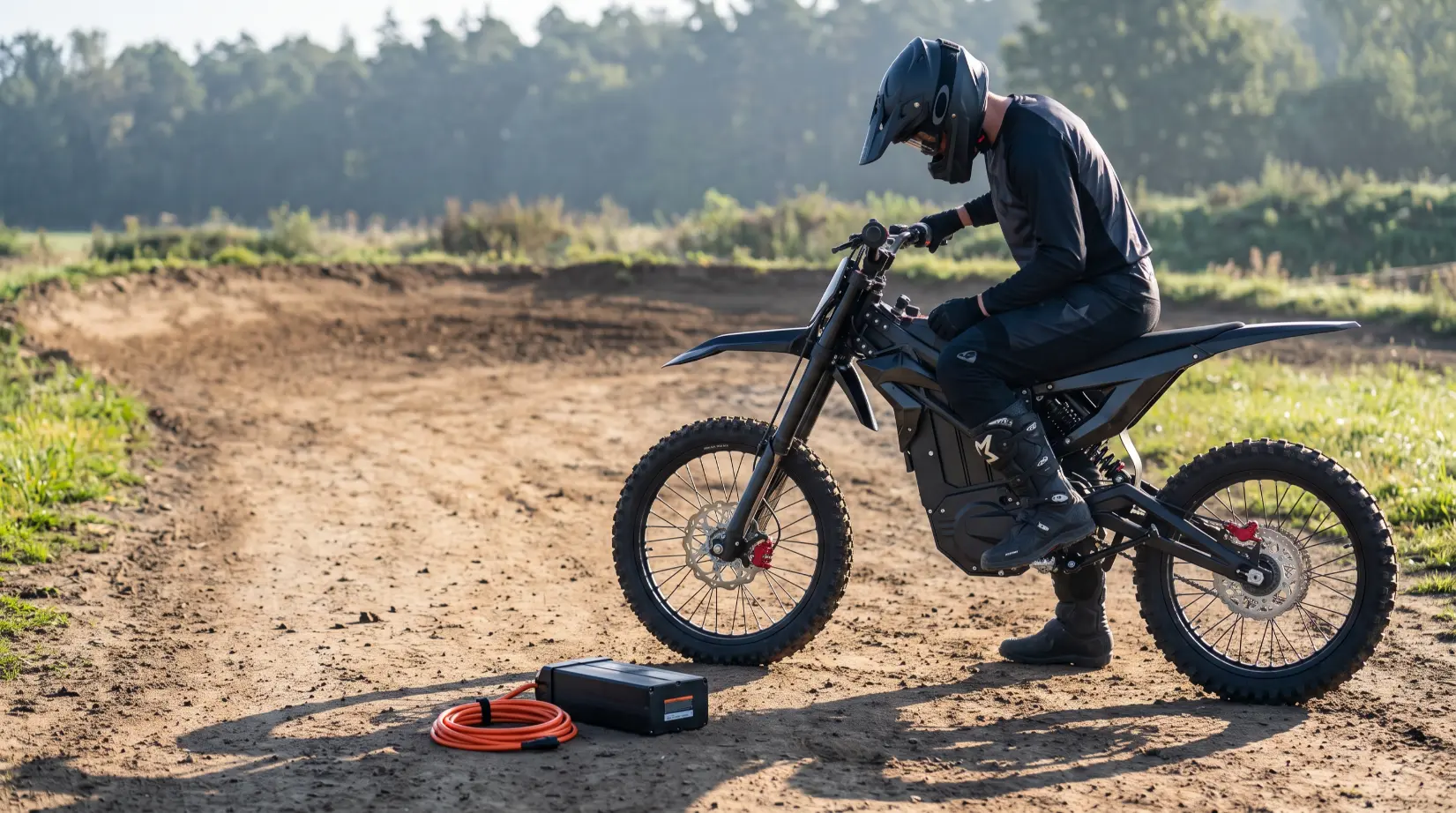
A swappable pack changes the shape of a riding day far more than a faster charger does. Charging from empty takes 3 to 6 hours depending on the pack and the available supply, which suits a machine that sits in a shed overnight and does not suit one that is standing at a trail head in the middle of a long afternoon. Carrying a second pack and swapping it in a couple of minutes turns an enforced wait into a short pause. Our packs come in 35, 40 and 45 Ah versions, so you can match capacity against the length of your typical session instead of paying for energy that you will never spend on a ride.
Think about your own pattern before you choose a capacity, because the right answer depends entirely on how you ride. A rider who does two-hour sessions on a home loop needs one pack and an overnight charge, and a larger pack would only add weight and cost to every single lap. Alternatively, a rider who travels to a trail centre for a full day, or who shares one bike between two people, gets far more value from a second pack than from any other upgrade on the list. In particular, the 40 Ah middle option covers most recreational use without much compromise, which is why we keep three capacities in the range rather than one fixed specification. What we found in testing was that pack choice moved rider satisfaction further than any other single line on the specification sheet.
What we will not do is translate charging time into distance, because anyone who promises that a certain number of minutes of charging equals a certain number of kilometres has left duty cycle, terrain and payload out of their arithmetic.
What Electric Does Not Solve
Three situations still favour a petrol machine, and pretending otherwise would waste your money and your weekend. The first is a long continuous ride, because a battery gives back only what you put into it and the day has to include charging time somewhere. The second is a remote area with no power supply at all, where range anxiety stops being a feeling and becomes a straightforward logistics problem. The third is a long cross-country journey that depends on fuel infrastructure, which electric dirt bikes are simply not built to use. In contrast, a rider who stays within a few hours of home and a wall socket will never meet any of those three limits, so the petrol argument only applies to a specific kind of trip.
There is also a safety point that applies to both types of machine, and it matters more than any specification. The US Consumer Product Safety Commission warns riders to stay off paved public roads, because off-road vehicles are not designed for that surface and become unstable or hard to see in traffic (CPSC, 2026). The same agency recommends age-appropriate machines for younger riders and helmets plus protective gear at all times. Those rules do not change because a bike is quiet, and a quiet bike can actually be harder for other trail users to notice. Therefore, ride defensively and assume that nobody has heard you coming until they can see you.
Honesty about limits is part of how we test, so our riders report the cases where a petrol machine would have been the better choice. We would rather you buy the right bike from someone else than the wrong bike from us.
Frequently Asked Questions
How far can an electric dirt bike go?
Our factory test riders measured up to 128 km on our test loop, and our catalogue figures are 115 km for the E60 and 140 km for the E72 under a steady 30 to 35 km/h cruise (BSE Motor, 2026). Your own distance will depend on payload, terrain, temperature and throttle use, so treat those numbers as planning ceilings rather than as promises. A heavier rider climbing loose ground in cold weather will see less than a light rider on flat trails.
Is 72V better than 60V?
Neither voltage is better in the abstract, because voltage selects a platform rather than a performance level. A 72V system can spin a motor further and run cooler at the same power, while a 60V system can still be quicker if it carries more current through the controller and turns shorter gearing. Therefore, compare the bikes rather than the labels. Check motor specification, controller current, gearing, pack capacity and kerb mass before you decide.
How long does the battery last?
We do not publish a lifespan in years or in charge cycles, because we have no verified figure for it and an invented one would mislead you. Instead, plan around swappable packs and treat capacity as a wear item you can replace. Keep the pack out of sustained direct sun, avoid storing it fully charged for months on end, and you will get a practical service life without relying on a number nobody can stand behind.
Can you swap the battery?
Yes, and a swap takes a couple of minutes with no tools beyond what you already carry. Our packs come in 35, 40 and 45 Ah versions, so carrying a spare effectively doubles your available energy for the day. On a long ride that matters far more than a marginal gain in charging speed, which is why we designed the platform around a removable pack in the first place.
Is electric good for beginners?
It often is, because there is no clutch and no gearbox to coordinate, so a new rider can concentrate on balance and throttle control instead of on timing. However, instant torque deserves respect, and a light bike that pulls hard from zero can still surprise someone who has never ridden before. Check the seat height, learn on gentle ground, and use any low-power riding mode the bike offers until the controls feel automatic.
Conclusion
Three ideas are worth keeping, and all three cost nothing to apply. Voltage is a platform choice rather than a speed rating, so compare it last. Range is stored energy divided by how hard you ride, so the duty cycle matters as much as the pack does. Weight is the advantage riders feel most often, because a 60 to 70 kg machine is easier to pick up, load and live with than a 100 to 120 kg one.
Your next steps:
- Write down the length of your typical session before you compare any specification.
- Compare kilowatt-hours and kerb mass first, then look at the voltage label.
- Decide whether a second pack suits you better than one larger pack.
- Check the seat height and try the bike on the kind of ground you actually ride.
Continue Learning
- How motor wattage and voltage relateWatts, volts and amps explained together.
- Choosing a first dirt bike as an adultSeat height, power and what to ignore.
- How electric ATVs compare with gas ATVsThe same trade-offs on four wheels.
- Browse our electric dirt bikes60V and 72V platforms with swappable packs.
- See the full dirt bike rangeEvery model we currently build.
- See the ATV rangeFor riders who want four wheels.
Specs for the models this guide talks about
Figures below are taken from our own product documentation (BSE Motor, 2026).
BSE PH12A — 150cc enduro
- Seat height 860 mm
- Kerb mass 89 kg
- Ground clearance 300 mm
- 7.5 kW at 8,500 rpm, five gears
BSE PH12B — 250cc enduro
- Seat height 880 mm
- Kerb mass 103 kg
- Ground clearance 330 mm
- 12 kW at 7,500 rpm, five gears
Explore the BSE Motor electric range
Swappable 60V and 72V packs, forged aluminium frames, and every unit bench tested before it ships.
View electric dirt bikes →References
- US Consumer Product Safety Commission. All-Terrain Vehicle Safety. Accessed September 2026.
- US Consumer Product Safety Commission. ATV Safety Information Center. Accessed September 2026 (CPSC, 2026).
All performance figures in this article were measured by our own factory test riders and on our own bench equipment, so they are not independent laboratory results (BSE Motor, 2026). This article was written by Mojo and reviewed by our engineering team. You can read more about us on the site, or contact our team with questions about a specific model.
 EN
EN  FR
FR  DE
DE  AR
AR  RU
RU  ES
ES  PT
PT  CN
CN