Key Takeaways
- The first question for an adult buyer is not how much power the ATV makes, but whether you fit the riding position and can right the machine if it tips over.
- Our ATV seat heights run from 700 mm to 830 mm, and the spread exists to fit different riders rather than to rank models.
- Wheelbase separates the models more cleanly than displacement does, at 1060 mm on the shorter chassis and 1180 mm on the longer one.
- Our petrol ATVs carry a kerb mass of 89 kg on the larger chassis, and our electric ATVs list a payload range of 55 to 180 kg.
- Three tests at the dealership settle a purchase faster than any specification table, and all three take less than five minutes.
Most ATV buying advice for adults starts with engine size, moves on to a table of rider heights, and finishes with a recommendation that nobody can verify. That order is backwards, because a machine you cannot control is not improved by giving it more power. An adult rider meets three real constraints, and they arrive in a fixed order: do you fit the riding position, can you right the machine if it tips, and can it actually do the work you bought it for. We measured seat height, wheelbase, suspension travel and kerb mass across our own range, and those figures make the trade-offs visible instead of leaving you to guess. As a result, this article works through the three constraints in order and puts a number against each one.
Height matters, and it matters less than most guides suggest, because a tall rider on a light machine is far safer than a short rider on a heavy one. In addition, the ground you ride on changes the requirement, so a fit table on its own cannot answer the question. What follows is the decision order we would use ourselves, with the numbers behind it.
Three Constraints Adults Hit
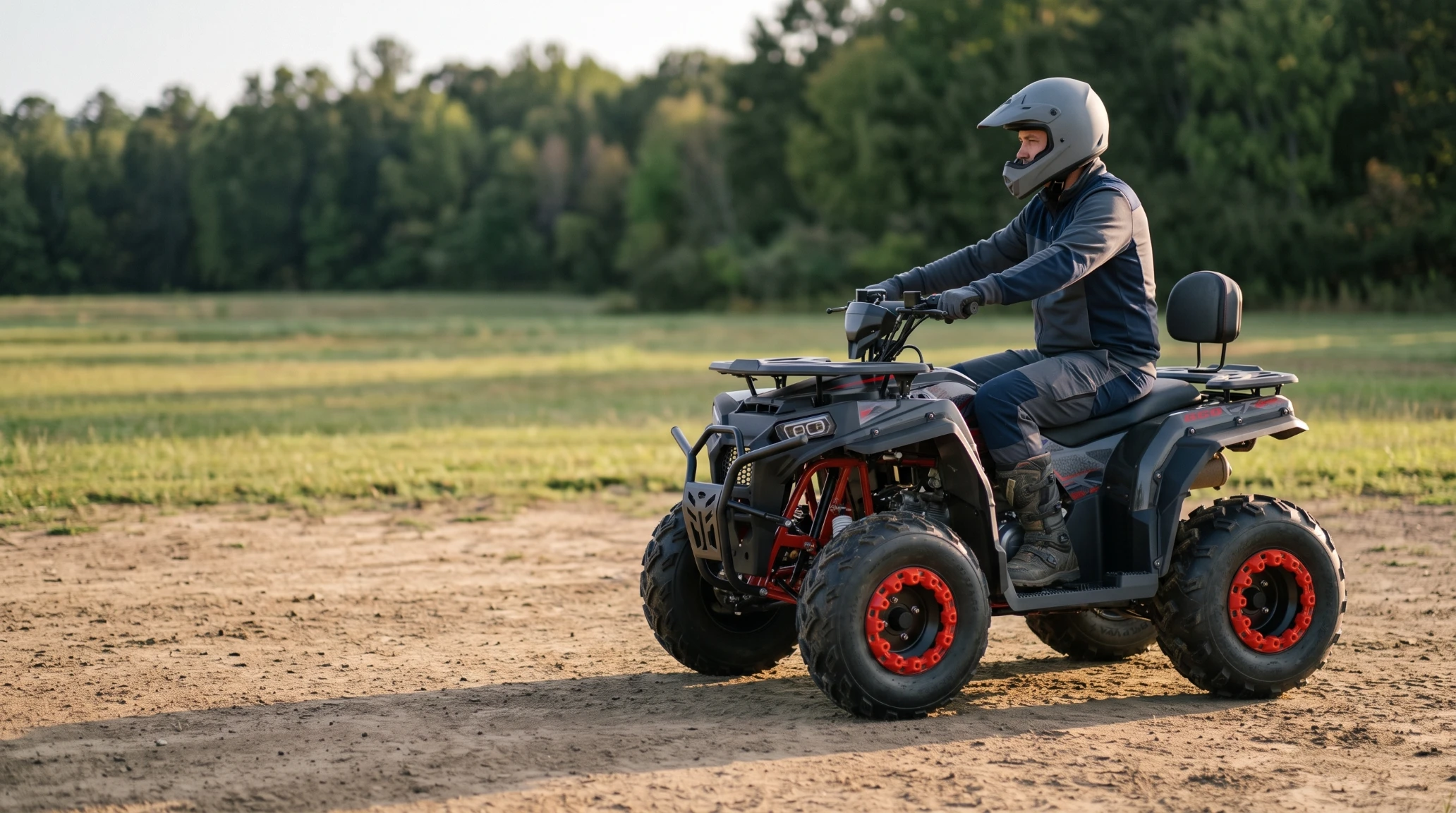
The first constraint is whether you fit the riding position, because a machine you have to fight is a machine you will not ride well. On an ATV the check is not whether your feet reach the ground, because your feet belong on the footrests: a foot dropped to the ground at speed is a broken ankle rather than a save. The check is whether both feet sit flat on the pegs, whether your knees bend comfortably instead of your legs stretching straight, and whether you can work the bars, the brake pedal and the gear selector without sliding forward in the seat. Seat height is the published figure that stands in for that cockpit, which is why it is the first number worth reading on the specification sheet. In our experience, a rider who has to shuffle in the seat to reach a control will ride tense, and a tense rider stops less often than the trail asks.
The second constraint is whether you can lift the machine after a tip, and it is the question almost nobody asks before buying. An ATV that falls on its side has to come back onto its wheels, and that job depends on mass and on how the weight sits. Therefore kerb mass matters more than it appears to on a brochure, because the difference between a machine you can right alone and one that needs a second person decides where you feel safe riding. We suggest testing this at the dealership rather than discovering it on a hillside, and the test costs nothing but a minute of effort — the US Consumer Product Safety Commission treats this as a safety question rather than a convenience one. In addition, technique counts for a great deal here, since a rider who knows where to stand and which way to push manages a heavier machine than a rider who simply pulls at the bars. Consequently, a machine at the edge of your strength is acceptable if the technique is comfortable, and a machine well inside your strength is not if it is not.
The third constraint is whether the machine can do the work, which is where load capacity and gearing enter the picture. A rider who tows a small trailer, carries fencing tools or hauls feed needs a machine with enough capacity and enough low-speed pull to move that weight without straining. Consequently the third question belongs last, because it only becomes relevant once the first two answers are acceptable. Answer them in that order and a surprising number of models eliminate themselves before you reach a comparison of features.
The Fit Table
Seat height across our range runs from 700 mm to 830 mm, and that spread is the most useful number a buyer can carry into a showroom. Our SA125 sits at 700 mm with 7-inch rims and 710 mm with 8-inch rims, which makes rim choice a genuine fit decision rather than a cosmetic one. The SA180 raises the seat to 780 mm, and the UA180 lifts it to 830 mm with the longest chassis in the range. We measured every one of those figures on our own machines rather than copying nominal catalogue values, because a specification that arrives from a marketing document rarely survives contact with a tape measure. In our experience, a 10 mm change in seat height is enough to alter how confident a rider feels at a standstill, so the four values in the table below are worth reading closely even though they look similar at a glance.
Wheelbase separates the range even more clearly, and we only publish the values we could verify. The SA180 runs a 1060 mm wheelbase and the UA180 runs 1180 mm, while ground clearance sits at 160 mm on both. Suspension travel ranges from 270 mm to 310 mm across the line-up, with the longest travel on the UA180. In addition, the petrol machines carry a kerb mass of 89 kg on the larger chassis, which is the figure that decides whether an adult can right the machine alone. We would rather publish four verified seat heights than forty unverified ones.
| Model | Seat height | Wheelbase | Clearance | Suspension travel | Power |
|---|---|---|---|---|---|
| SA125, 7-inch rims | 700 mm | Not published | Not published | 275 / 270 mm | 4.7 kW (110cc) |
| SA125, 8-inch rims | 710 mm | Not published | Not published | 275 / 270 mm | 6.3 to 7.3 kW |
| SA180 | 780 mm | 1060 mm | 160 mm | 275 / 270 mm | 8.3 kW, 89 kg kerb |
| UA180 | 830 mm | 1180 mm | 160 mm | 310 / 310 mm | 8.3 kW, 89 kg kerb |
Two cells in that table read as not published, and that is deliberate. We do not list a wheelbase or a clearance figure for the SA125 because the number we have does not pass our own sanity check, and printing it would be worse than leaving the cell empty. The same rule applies to load capacity on the petrol machines, which we explain in the next section. A fit table is only worth reading if every number in it survives scrutiny, so we would rather have gaps than corrections.
Weight and Power
Kerb mass decides whether you can pick the machine up, and power decides how hard it pulls once the machine is upright. Those two properties get confused constantly, because both appear as numbers on the same line of a specification sheet. Our larger petrol ATVs carry 89 kg of kerb mass, which one adult can usually right with good technique on flat ground and which becomes a real problem on a slope after a long day. Therefore we treat mass as a safety figure rather than a performance figure, and we would choose a lighter machine over a more powerful one whenever the two conflict. That preference is unusual in this category, where bigger engines are easy to sell, and it comes from watching riders ride well on modest machines and badly on heavy ones.
Payload is where our petrol and electric ranges differ, and honesty about the gap matters more than filling it. Our electric ATVs list a payload range of 55 to 180 kg, and our petrol ATV pages do not publish a payload figure at all. That is a data gap rather than a design feature, so we are telling you to confirm it with your dealer rather than suggesting a number we cannot support. Power across the range runs from 4.7 kW at the small end to 8.3 kW at the top, with 6.3 kW and 7.3 kW in between on the mid-size machines. Specifically, the 110cc and 125cc machines produce the lower figures, and the larger chassis produces 8.3 kW. A buyer who tows or carries should therefore treat the payload question as unanswered until the dealer puts a figure in writing, because guessing here costs money twice.
Power matters most on climbs and when you carry a load, and it matters least at the standstill where most buying decisions actually get made. In other words, a rider who struggles to hold a machine upright gains nothing from a larger engine, and a rider who is comfortable with the weight gains real capability from the extra output. For that reason we ask buyers to settle the fit questions first and the power question second, and the order keeps surprises off the trail. A heavier rider on a steep grade will notice the difference between 4.7 kW and 8.3 kW within a hundred metres, while the same rider on flat ground will barely notice it at all. You can see the whole range of ATVs, the utility ATVs and the sport ATVs laid out by chassis rather than by engine size.
Terrain Decides the Chassis
Terrain sets wheelbase and suspension travel, and displacement influences those choices far less than most buyers assume. Our 1060 mm wheelbase machine turns more tightly, which suits wooded trails, fence lines and any ground where the rider has to change direction often. The 1180 mm chassis tracks straighter and feels more settled at speed, which suits open fields, long lanes and hauling loads. Therefore the chassis tells you which terrain the machine was aimed at, and the engine only tells you how quickly it gets there. Similarly, the sport models in our range use the tighter chassis while the utility models use the longer one, so the category name itself already answers half the question.
Suspension travel follows the same logic, because ground that is rough over a long distance needs more travel to absorb it. Our shorter-travel setups run 270 mm, and the longer-travel UA180 runs 310 mm, which is the machine we would point at open or broken ground rather than at tight woodland. In our experience, riders choose by displacement and then discover that the chassis does not match where they ride, which is an expensive way to learn the lesson. Sand, mud and rock each ask for something different, and none of them care how many cubic centimetres the engine displaces. Meanwhile, a rider who alternates between tight woodland and open ground has to accept a compromise, and the shorter chassis is usually the easier one to live with.
The practical rule is simple enough to remember. Short wheelbase and shorter travel for tight technical ground, longer wheelbase and longer travel for open ground and load carrying. Everything else, including tyre choice, follows from that first decision, and a rider who starts from the terrain will rarely regret the machine they end up with.
Three Tests at the Dealership
Three minutes of testing at a dealership tells you more than an hour of reading specifications, and every one of the tests uses equipment the dealer already has. Sit on the machine while wearing your riding boots, plant both feet flat on the footrests, and work every control — throttle, brake pedal, gear selector — without sliding forward in the seat or reaching for anything. The ATV riding technique guide covers the same check, and it is the one the ASI teaches. If you cannot, the machine does not fit the riding you plan to do, regardless of how good it looks standing beside it. This is the first gate from earlier in this article, and it eliminates more machines than any other check. Admittedly, a showroom floor is flat and a trail is not, so treat the test as a best case rather than as a guarantee.
The second test is to lean the machine onto its side, with permission and a spotter, and then right it yourself using the technique you would use on a trail. That test measures the mass in a way no number can, because the effort depends on where the weight sits as much as on the total. The third test is to turn the bars from full lock to full lock while seated, which shows you the turning circle the wheelbase produces. Consequently you leave with three real answers instead of a set of impressions. However, do not skip the spotter, because a machine that rolls while you test it can hurt someone standing nearby.
Ask the dealer for the figures we could not publish as well, specifically the payload rating and the wheelbase for any model that does not list one. A dealer who can produce those numbers from a factory document is a dealer worth buying from, and the request itself tells you something useful about the business.
Frequently Asked Questions
What size ATV for an adult?
Start from the riding position rather than from engine size, because a machine you cannot sit on properly is not made safe by extra power. Sit the machine with your riding boots on and check that both feet rest flat on the footrests and that every control is within reach without sliding forward in the seat. Seat height is the figure that stands in for that cockpit, and our range runs from 700 mm to 830 mm. Then check kerb mass against your ability to right the machine, and only then compare power (BSE Motor, 2026).
Can a 125cc ATV carry an adult?
It can carry an adult on light duty, and the honest answer depends on the work. Our 110cc and 125cc machines produce between 4.7 kW and 7.3 kW, which is enough for a single adult on gentle ground and not enough for heavy hauling on steep terrain. Consequently, check the payload rating for the specific model, because drivetrain and chassis capacity matter as much as engine output.
How heavy is too heavy?
There is no universal kilogram threshold, because it depends on your size, your strength and the ground you ride on. The practical test is to right the machine yourself at the dealership with a spotter present, using the technique you would use on a trail. If that effort is near your limit on flat concrete, it will be beyond it on a slope (CPSC, 2026). In addition, fatigue matters, because the same machine feels heavier at the end of a long day than it does at the start.
Do I need 4×4?
Four-wheel drive helps in mud, snow and loose climbs, and it costs weight and complexity everywhere else. A rider who stays on dry trails and fields rarely needs it, while a rider who works in wet conditions will want it — the trade-off is covered in more detail in our electric and petrol ATV comparison. Therefore match the drivetrain to the worst ground you realistically ride, not to the worst ground you imagine riding.
Conclusion
Three ideas decide an adult ATV purchase. Do not buy on displacement, because power answers a question you have not asked yet. The riding position and the kerb mass decide whether you can control and right the machine, and those two checks come first. Then let the terrain pick the chassis, since wheelbase and suspension travel follow the ground rather than the engine.
Your next steps:
- Sit the machine with your riding boots on and confirm that both feet sit flat on the footrests and every control is within reach.
- Ask for the payload rating and wheelbase of any model that does not publish them.
- Right the machine yourself at the dealership before you decide.
- Match wheelbase and suspension travel to the ground you actually ride.
Continue Learning
- How electric ATVs compare with gas ATVsCost, weight and range differences on four wheels.
- ATV riding techniques for beginnersBody position, turns and climbing.
- ATV maintenance essentialsKeeping a working machine working.
- How to ride an ATV safelyTechnique and risk management on four wheels.
- Browse our utility ATVsLonger wheelbase and more travel.
- Browse our sport ATVsTighter chassis for technical ground.
Specs for the models this guide talks about
Figures below are taken from our own product documentation (BSE Motor, 2026).
BSE SA125 — 110 / 125 / 140cc utility ATV
- Seat height 700 mm (7" wheels) / 710 mm (8" wheels)
- Power 4.7 / 6.3 / 7.3 kW
- Suspension travel 275 / 270 mm
- 1 forward + 1 reverse, or 3 forward + 1 reverse
BSE UA180 — 180cc utility ATV
- Seat height 830 mm
- Wheelbase 1180 mm, clearance 160 mm
- 8.3 kW at 6,000 rpm
- Suspension travel 310 / 310 mm
Find the ATV that fits you
Measured seat heights, two wheelbase options, and a payload rating for every electric model.
View ATVs →References
- US Consumer Product Safety Commission. All-Terrain Vehicle Safety. Accessed September 2026.
- US Consumer Product Safety Commission. ATV Safety Information Center. Accessed September 2026 (CPSC, 2026).
Seat height, wheelbase, clearance, suspension travel, kerb mass and power figures in this article were measured by our own engineers on our own machines, so they are not independent laboratory results (BSE Motor, 2026). Payload figures for electric models come from our own product documentation (BSE Motor, 2026). This article was written by Mojo and reviewed by our engineering team. You can read more about us on the site, or contact our team with questions about a specific model.
 EN
 FR
 DE
 AR
 RU
 ES
 PT
 CN