
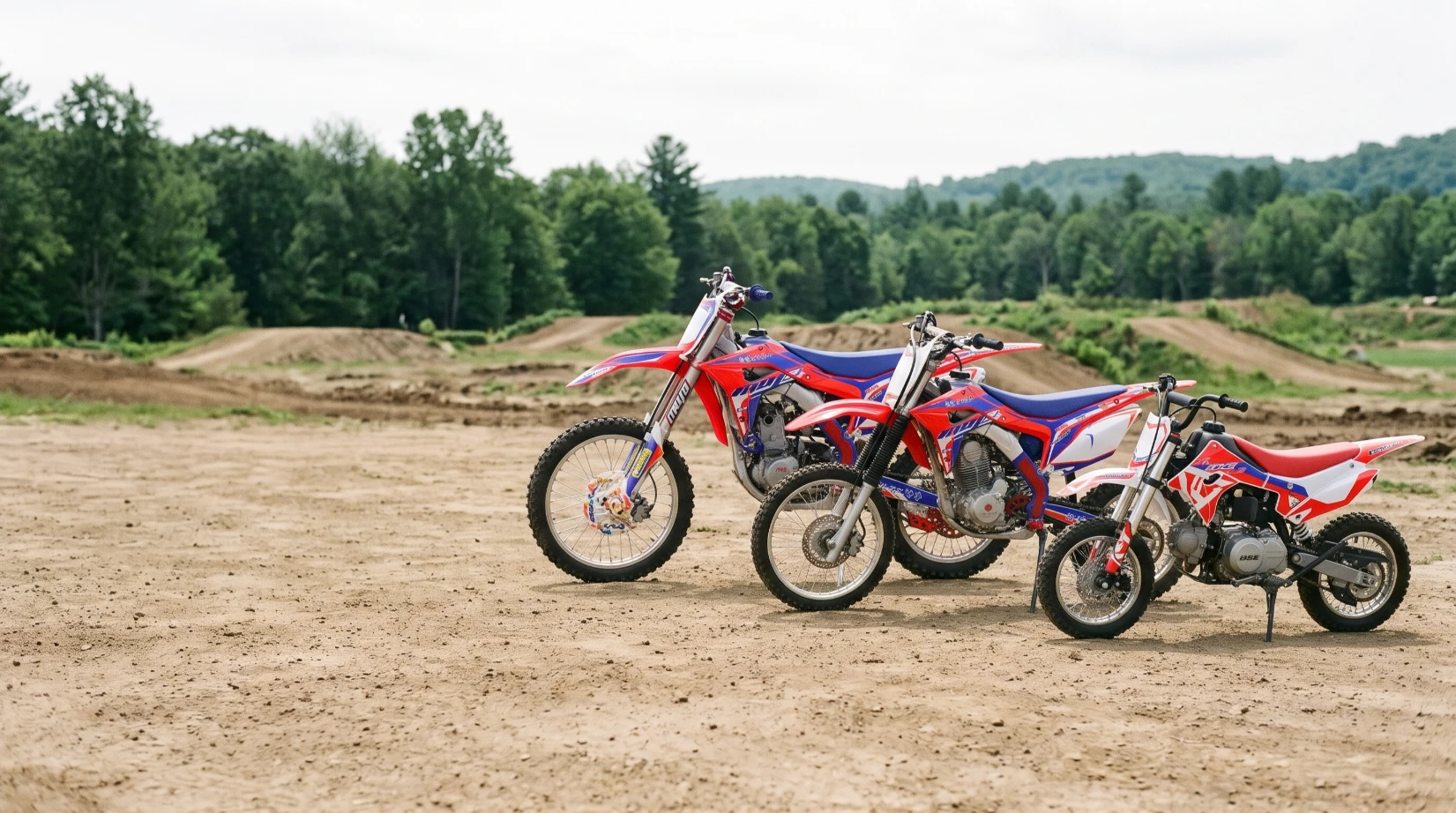
Key Takeaways
- On a motocross bike, rider weight matters more than rider height, because weight sets the suspension setup and decides which class the rider belongs in.
- Our range runs from 46 kg to 122 kg in kerb mass, which spans a youth machine and a full-size race bike in one line-up.
- Engine output across our adult machines runs from 12 kW to 19 kW within the same 250cc capacity, so displacement alone tells you very little.
- Our 300cc model makes 18.5 kW at 8,500 rpm, while an older 223cc design produces 12 to 13 kW, which is why the table below pairs weight with output rather than with capacity.
- Suspension has to be reset for every change of rider, and fork travel across seven of our models ranges from 735 mm to 940 mm with some units non-adjustable.
Motocross sizing guides usually start with height, and that starting point produces the wrong answer for most riders most of the time. The reason is that a motocross bike carries its weight in a way that a trail bike does not, because the rider stands for most of a moto and the suspension works through a much longer stroke. Rider weight sets the spring rates and the damping that the machine needs, and it also decides which class a rider can race in without being outmatched. Therefore a heavier rider and a lighter rider of the same height need different machines, different setups and often different classes. We measured kerb mass, output, seat height and fork travel across our own range, and the figures below come from those measurements rather than from a catalogue.
One clarification before the detail. This article covers sizing rather than riding technique, and our separate guide to what a motocross bike is built for covers the difference between race and trail machines.
Why Weight, Not Height
Rider weight decides the suspension setup, and the suspension setup decides whether the machine works or fights the rider. A motocross fork and shock are set for a mass, and a rider outside that mass range either uses too little of the travel or uses all of it on every landing. In addition, a heavier rider accelerates the machine out of a corner differently, which changes gearing requirements as well as suspension settings. Consequently, the first number to establish is the rider’s weight in riding gear, and every other decision follows from it. Our own range spans 46 kg to 122 kg in kerb mass, so the range of riders the line-up can serve is wide. Consider a 70 kg adult and a 95 kg adult of the same height, because those two riders need different spring rates and will feel the difference within one lap of a rough section.
Class rules reinforce the point, because youth and amateur classes around the world are organised partly by machine capacity and partly by age, and the two interact with weight. A rider who is heavy for their age can be competitive on a larger machine in a younger class, while a light rider of the same age can be outmatched. Therefore the sizing question is not which bike is biggest but which combination of capacity and setup lets the rider use the machine properly. In our experience, riders who size by weight improve faster than riders who size by height, because they spend less time managing a machine that does not fit.
There is a practical test that takes two minutes, and it does not require a scale at the track. Sit the rider on the machine, then have them stand on the pegs in riding position and compress the suspension by bouncing their weight. Watch how much of the travel is used, because a machine that uses almost all of it at rest has no travel left for a landing. We do not publish a sag measurement in millimetres, because we have no verified figures for one and the value depends on the rider and the model. Instead, ask whether the fork and shock are adjustable at all, because that single fact decides whether the machine can be set up for the rider in front of you.
The Weight-to-Displacement Table
A weight-to-displacement table is the practical tool in this category, and it works because it pairs the two properties that a rider can actually choose between. Our adult machines cover a power range from 12 kW to 19 kW within a single 250cc capacity, which means the capacity figure cannot carry the decision on its own. Our 300cc model makes 18.5 kW at 8,500 rpm, and an older 223cc design that the industry has used for more than twenty years produces only 12 to 13 kW. Therefore, the useful pairing is rider weight against machine output and kerb mass, with capacity as a secondary label.
| Rider and machine | Kerb mass | Output | What to check |
|---|---|---|---|
| Youth riders on the smaller frames | From 46 kg upward | Smaller platforms | Seat height and control reach first |
| Adults on 250cc models | Within our line-up’s mid range | 12 kW to 19 kW across our 250cc models | Whether the tune suits the rider’s weight |
| Adults on our 300cc model | Within our line-up’s mid range | 18.5 kW at 8,500 rpm | Suspension adjustability and gearing |
| Full-size race machines | Up to 122 kg | Higher output platforms | Physical fit and recovery after a fall |
Read that table as a map of the range rather than as a ranking, because a larger machine is not automatically a better one. A rider at the light end who moves up too early gains power they cannot use and losses in handling they will feel on every corner. A heavier rider on a machine at the small end spends the moto fighting the suspension instead of riding. Consequently, the correct row in the table is the one that matches the rider’s weight and skill together, and the capacity label is the least informative column in it. For example, a light rider moving onto a machine at the top of the output range gains power they cannot use and loses the handling they were relying on.
Two figures in the table deserve a specific note, because they are the ones buyers most often misread. Kerb mass decides what happens after a fall, since a rider who cannot lift the machine will avoid the terrain where they would learn the most. Output decides how much work the rider has to manage, and the range within a single capacity is wide enough that two 250cc machines can feel completely different. Therefore, check both figures against the rider rather than against a class name, and treat the class name as a label rather than as a specification. Similarly, a machine that suits a rider in the showroom may not suit them after a growth spurt, so revisit the pairing each season.
Suspension Must Be Reset
Suspension must be reset whenever the rider changes, and this is the step that buyers most often skip when they move up a size. A machine set up for the previous rider will feel harsh to a lighter one and soft to a heavier one, and either way the rider will blame the bike. Fork travel across our seven models ranges from 735 mm to 940 mm, with some units adjustable and some not, which means the reset can be a matter of turning clickers or a matter of living with it. Therefore, establish whether your machine adjusts before you plan any setup work at all.
Where the fork adjusts, three settings carry most of the difference, and none of them needs a workshop. Compression damping controls how the fork behaves as it absorbs an impact, rebound controls how quickly it returns to position, and spring preload sets how much travel the rider uses at rest. We are not going to publish a factory setting calibrated to an average body weight, because we have no verified figure for one and the claim appears more often in marketing copy than in engineering documents. Work from your machine’s own manual, change one setting at a time, and ride the same short loop after each change. In our experience, riders who change three settings at once cannot tell which one worked, and they usually revert all three and start again.
Two habits make the difference between a setup that works and a setup that drifts. Write down what you changed and when, because a machine that feels wrong after four adjustments is easier to return to a known state than to diagnose. Then recheck the setup when the rider’s weight changes, which happens more often with young riders than anyone expects. In our experience, a rider who keeps a note of the settings ends up with a machine they understand, and a rider who does not ends up paying someone else to guess.
Height Still Matters for the Frame
Height still matters, and it matters for the frame rather than for the suspension, which is why it comes second rather than first. Seat height across our range runs from 570 mm to 960 mm, and that range covers a small child’s machine and a full-size race bike in the same line-up. A rider who cannot reach the ground at a standstill will avoid stopping on uneven ground, which removes most interesting terrain from their riding. Consequently, the physical check belongs in the decision alongside the weight calculation, and neither one replaces the other.
The check itself is simple, and it works better in riding boots than in anything else. Sit the rider on the machine with an adult holding it upright, and look for the balls of both feet reaching the ground. Then ask the rider to reach the handlebar, the brake lever and the gear lever without stretching or sliding forward on the seat. In our experience, a rider who passes both checks learns faster, because confidence at a standstill is what allows a beginner to look at the ground ahead rather than at the machine beneath them. Consider how often a rider stops on uneven ground, because that situation is where a short rider loses confidence first.
Reach matters as much as seat height on a motocross machine, and it is the part that a height chart cannot capture. Motocross machines have wide bars and long lever spans, and a rider who has to move a hand to reach the front brake will brake late in every corner. Therefore, check the lever span and the bar position as part of the same two-minute test, and adjust them before the first ride rather than after the first fall. Both adjustments are free on most machines.
Stepping Up
Stepping up should follow demonstrated control rather than a calendar or a growth spurt, and the signals are easy to recognise once you know what to look for. A rider is ready for a larger machine when they can start and stop on command, hold a line through a rut, and ride a full session without the machine dictating the pace. Until those three are true, extra capacity adds risk rather than progression. Consequently, keep the rider on the current machine until the skills arrive, and treat the upgrade as a reward for the skills rather than a substitute for them. In our experience, riders who move up on that basis rarely move back down. However, the step itself is worth planning, because a rider who moves up mid-season often loses the progress they had built on the smaller machine.
The second signal is physical, and it concerns recovery rather than riding. A rider who cannot lift the current machine will struggle with a heavier one, so the kerb mass of the next machine should be checked against the rider’s strength rather than against their height. Our range runs to 122 kg at the top end, which is a machine that most young riders cannot right alone, and that fact alone should delay some upgrades. Therefore, work out who will be present when the machine falls, and size the machine for that person as well as for the rider. Similarly, a rider who rides alone should stay below the mass they can lift themselves, whatever the class rules allow.
Money matters too, and a measured step up usually costs less than an immediate one. A rider who spends a season on a well-set-up mid-size machine learns more than a rider who jumps two sizes and spends the season managing the bike. In addition, the mid-size machine holds its place in the line-up for a sibling or a second season, which makes it the cheaper route as well as the safer one. Finally, the commission recommends a helmet and protective equipment at every ride, and that budget should not be spent on capacity instead.
Frequently Asked Questions
What size motocross bike should I ride?
Size by rider weight first, because weight sets the suspension setup and the class, and then check seat height against the rider’s reach. Our range runs from 46 kg to 122 kg in kerb mass and from 12 kW to 19 kW in output within a single 250cc capacity, so the pairing matters more than the capacity label (BSE Motor, 2026).
Is a 250cc motocross bike too much power?
It depends on the tune rather than on the capacity. Our 250cc models run from 12 kW to 19 kW, which is a spread of more than 50 percent. Our 300cc model makes 18.5 kW at 8,500 rpm, while an older 223cc design produces 12 to 13 kW. Check the output figure for the specific model.
How do I know if the suspension is set up for me?
Establish first whether the fork and shock are adjustable, because some of our models are not. Where they adjust, change one setting at a time and ride the same short loop after each change. Sit on the machine and bounce your weight to see how much travel is used at rest, and check your own manual for the procedure.
Does rider height matter on a motocross bike?
It matters for the frame rather than the suspension. Seat height across our range runs from 570 mm to 960 mm. Check that the balls of both feet reach the ground and that the rider can reach the bar, brake and gear lever without stretching. Then adjust lever span and bar position before the first ride (CPSC, 2026).
When should a rider move up a size?
When they can start and stop on command, hold a line through a rut, and finish a session without the machine setting the pace. Check the kerb mass of the next machine against the rider’s strength as well, since our range reaches 122 kg. Size the machine for whoever will lift it when it falls.
Conclusion
Three ideas fix motocross sizing. Start from rider weight, because weight sets the suspension setup and the class, and then check seat height for the frame. Use a weight-to-output pairing rather than a capacity label, since 250cc machines can differ by more than two and a half times in output. Then move up on demonstrated control, and check the next machine’s mass against whoever will lift it.
Your next steps:
- Weigh the rider in full riding gear before comparing models.
- Check whether the fork and shock adjust on the machine you are considering.
- Test seat height, bar reach and lever span in riding boots.
- Confirm the rider’s strength against the next machine’s kerb mass before stepping up.
Continue Learning
- Motocross vs trail bikeWhat each machine is built to do.
- First dirt bike: mistakes beginners makeFit, gear, displacement and setup.
- Dirt bike upgrades that matterRanked by effect per unit of cost.
- Browse our dirt bikesYouth and full-size models.
Specs for the models this guide talks about
Figures below are taken from our own product documentation (BSE Motor, 2026).
BSE M250 — 250cc competition motocross
- Seat height 940 mm
- Kerb mass 116 kg
- Ground clearance 290 mm
- 19 kW at 9,000 rpm, six gears
BSE M450 — 450cc competition motocross
- Seat height 950 mm
- Kerb mass 122 kg
- 32 kW at 9,000 rpm, six gears
- Wheelbase 1,450 mm, clearance 290 mm
Find the right size for the rider
Kerb masses from 46 kg to 122 kg, seat heights from 570 mm, and fork travel up to 940 mm.
View dirt bikes →References
- US Consumer Product Safety Commission. All-Terrain Vehicle Safety. Accessed September 2026.
- US Consumer Product Safety Commission. ATV Safety Information Center. Accessed September 2026 (CPSC, 2026).
Kerb mass, engine output, seat height and fork travel figures in this article were measured by our own engineering team on our own machines, so they are not independent laboratory results (BSE Motor, 2026). This article was written by Mojo and reviewed by our engineering team. You can read more about us on the site, or contact our team with questions about a specific model.
 EN
 FR
 DE
 AR
 RU
 ES
 PT
 CN